The Toyota RAV4 is one of the world’s most popular SUVs, known for its reliability, comfort, and versatility. When it comes to choosing between the Toyota RAV4 Hybrid and the standard gasoline model, many buyers focus on one key question: What is the real-world fuel economy difference between these two options?
Official numbers are helpful, but real-life driving often tells a different story. This article takes a deep dive into real-world fuel economy for both the RAV4 Hybrid and the gas version. We’ll examine how they perform in daily life, what affects their mileage, and help you decide which RAV4 fits your needs best.
Understanding Toyota Rav4 Hybrid And Gas Models
Before comparing real-world fuel economy, it’s important to know what sets the RAV4 Hybrid apart from the gasoline RAV4. Both are compact SUVs, but their powertrains and technology differ in significant ways.
Toyota Rav4 Gas: Simple And Familiar
The gasoline RAV4 is powered by a traditional 2.5-liter four-cylinder engine. It produces about 203 horsepower and uses an eight-speed automatic transmission. Front-wheel drive (FWD) is standard, but all-wheel drive (AWD) is available as an option.
This model is straightforward and has been refined over years. It’s easy to maintain, and many drivers are familiar with its mechanics. The gas RAV4 is also often slightly cheaper to buy compared to the hybrid version.
Toyota Rav4 Hybrid: Efficiency With Power
The RAV4 Hybrid uses a 2.5-liter four-cylinder engine paired with two electric motors. Together, they create a total system output of 219 horsepower. All-wheel drive is standard on the hybrid, thanks to an extra electric motor on the rear axle.
This hybrid system uses a continuously variable transmission (CVT), which helps the car operate efficiently in different conditions. The hybrid battery is self-charging, so you never need to plug it in.
Why Compare Real-world Fuel Economy?
EPA ratings are useful, but they’re tested under ideal conditions. In actual use, factors like traffic, weather, driving style, and maintenance can change the results. Many drivers notice their real-world mpg is different from what’s advertised. That’s why it’s important to look at what RAV4 owners and independent testers experience on the road.
1. EPA Fuel Economy Ratings: A Starting Point
Let’s start with the official numbers. The EPA (Environmental Protection Agency) provides standardized fuel economy ratings for new vehicles. Here’s how the 2024 Toyota RAV4 models compare according to EPA estimates:
| Model | City (mpg) | Highway (mpg) | Combined (mpg) |
|---|---|---|---|
| RAV4 Gas FWD | 27 | 35 | 30 |
| RAV4 Gas AWD | 25 | 33 | 28 |
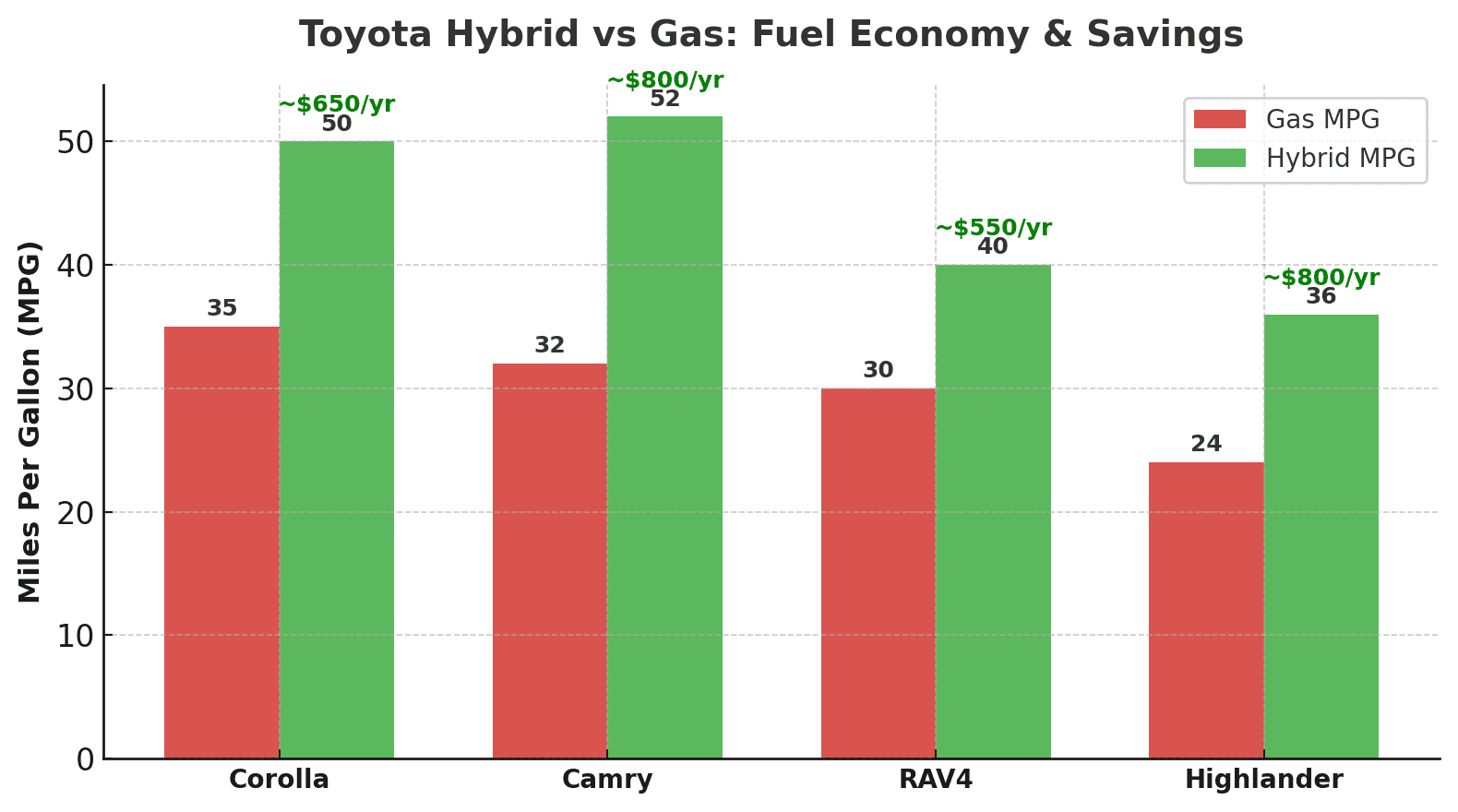
| RAV4 Hybrid AWD | 41 | 38 | 40 |
These numbers show the hybrid has a clear advantage—on paper, at least. But as many drivers know, real-world driving often tells a different story. Let’s see what actually happens on the road.
2. Real-world Fuel Economy: Owner And Test Results
Official ratings are a good start, but they don’t capture the full picture. Real-world fuel economy depends on many factors, including city versus highway driving, temperature, terrain, and individual habits.
Rav4 Gas: Real-world Experiences
Most owners of the gasoline RAV4 report real-world mpg that is close to, but often a bit lower than, the EPA estimates. According to user reports from sites like Fuelly and Consumer Reports, the typical real-world average for the gas RAV4 is:
- FWD models: 27–30 mpg
- AWD models: 25–28 mpg
City driving, heavy traffic, or aggressive acceleration can drop the numbers further—sometimes to 22–24 mpg. On the highway, some drivers do reach or even slightly exceed EPA numbers, especially with steady speeds and light loads.
Rav4 Hybrid: Real-world Experiences
The RAV4 Hybrid consistently impresses with its real-world numbers. Many owners see averages between 38 and 42 mpg, which often matches or even beats the EPA combined figure. Some drivers in mild climates and mostly city routes report over 44 mpg.
The hybrid’s biggest advantage appears in city driving and stop-and-go traffic, where its electric motors help save fuel. Even with AWD, the hybrid rarely drops below 35 mpg unless driving is very aggressive or in harsh winter conditions.
Read More: Best Roof Rack Cross Bars for Toyota Rav4
Comparing Real-world Data
Independent tests from sources like Car and Driver and MotorTrend confirm these trends. Here’s a summary based on their mixed-driving tests:
| Model | Tested Real-World MPG (Mixed) | Notes |
|---|---|---|
| RAV4 Gas AWD | 27 mpg | Close to EPA, drops in city driving |
| RAV4 Hybrid AWD | 40 mpg | Often exceeds EPA, especially in urban use |
It’s clear: The RAV4 Hybrid saves real fuel—not just on paper, but in daily life.
3. Factors Affecting Real-world Fuel Economy
Why do results vary so much between drivers and models? There are several important factors that influence real-world mpg for both the RAV4 Hybrid and gas models.
Driving Style
Aggressive driving—fast acceleration, hard braking, and high speeds—can hurt fuel economy in any car. However, the effect is often more dramatic in the gasoline RAV4. Hybrids use their electric motors to smooth out driving, especially in slow traffic, which helps keep mpg high even with frequent stops.
Traffic And Route Type
Stop-and-go city traffic is hard on gas engines but helps hybrids. The RAV4 Hybrid can run on electric power at low speeds or when coasting, so it uses much less fuel in traffic jams. On the other hand, long highway drives narrow the gap between the two models, though the hybrid still usually wins.
Weather And Temperature
Cold weather affects all cars, but hybrids can see a bigger drop in mpg during winter. Batteries are less efficient in the cold, and the engine runs more to heat the cabin. Some owners report winter mpg dropping by 10–15% for the hybrid, but the gas model is also affected, just less dramatically.
Cargo And Load
Carrying heavy loads or towing reduces fuel economy for both versions. The effect is more noticeable in the gas model, but hybrids can also lose efficiency if they’re always loaded or towing.
Tire Pressure And Maintenance
Low tire pressure, dirty air filters, and missed maintenance hurt mpg for both models. The hybrid’s computer systems can partly compensate, but regular care is still important.
Non-obvious Insight: Short Trips
One detail many drivers miss: very short trips are especially tough on fuel economy. When the engine is cold, both the gas and hybrid RAV4 use more fuel. The hybrid runs its engine more often to warm up, which can mean lower-than-expected mpg if most trips are under 5 miles.
Non-obvious Insight: Regenerative Braking
The RAV4 Hybrid uses regenerative braking to recharge its battery when you slow down. This feature saves fuel in city driving but has little effect on the highway. Drivers who coast to stops and avoid hard braking get the best benefit.
4. Fuel Economy Over Time: Long-term Ownership
Initial mpg is important, but what about after years of use? Both the RAV4 Hybrid and gas models are known for reliability, but their long-term efficiency can change.
Gas Rav4: Aging And Maintenance
The gasoline RAV4’s fuel economy may slowly decrease over time if the car isn’t maintained. Worn spark plugs, dirty fuel injectors, and old engine oil can all hurt efficiency. However, with proper care, many owners still get close to their original mpg after 5 or more years.
Rav4 Hybrid: Battery Life And Maintenance
Hybrid batteries are built to last, and Toyota’s system is famous for reliability. Most RAV4 Hybrid owners see little to no drop in mpg over the first 100,000 miles. Some early Prius models have gone 200,000+ miles without major battery issues, and the RAV4 Hybrid uses similar technology.
If the battery does start to lose capacity—usually after many years—the car will rely more on the gas engine, and mpg may drop. However, battery replacement is rare and often covered by long warranties. Regular hybrid system checks and software updates help maintain top efficiency.
Real-world Owner Experience
On owner forums, some RAV4 Hybrid drivers report seeing similar mpg after 7-8 years as when the car was new. Proper maintenance is key for both models, but the hybrid’s systems often help keep mpg consistent, especially if the battery remains healthy.
5. Cost Differences: Fuel Savings Vs. Purchase Price
While fuel economy is important, many buyers want to know if the hybrid’s higher efficiency leads to real savings over time. This means looking at fuel costs, but also the difference in purchase price.
Purchase Price Gap
The RAV4 Hybrid usually costs $1,200–$2,000 more than a similar gas model, depending on trim and options. However, hybrid models often include AWD as standard, which narrows the gap if you compare AWD to AWD.
Annual Fuel Cost Comparison
Let’s estimate the annual fuel cost for both models, assuming:
- 15,000 miles driven per year
- Gasoline price: $3.50/gallon
| Model | Real-World MPG (Average) | Gallons Used (Yearly) | Annual Fuel Cost |
|---|---|---|---|
| RAV4 Gas AWD | 27 mpg | 556 | $1,946 |
| RAV4 Hybrid AWD | 40 mpg | 375 | $1,313 |
Annual savings: About $630 per year for the hybrid over the gas model.
Payback Period
If the hybrid costs $1,500 more but saves $630 per year on fuel, the extra cost is recovered in about 2. 5 years. After that, all additional savings go into your pocket.
Other Ownership Costs
Insurance, taxes, and maintenance are usually similar. Some hybrid parts can be more expensive, but hybrids need fewer brake replacements thanks to regenerative braking. Oil changes are also less frequent on the hybrid because the engine runs less.
Credit: www.dickhannahtoyota.com
6. Environmental Impact: Less Fuel, Lower Emissions
Fuel economy isn’t just about saving money—it also affects the environment. The RAV4 Hybrid uses less gas, which means lower CO2 emissions and less air pollution.
- RAV4 Gas AWD: About 316 grams of CO2 per mile
- RAV4 Hybrid AWD: About 222 grams of CO2 per mile
Over 15,000 miles, the hybrid emits about 1,410 kg less CO2—a significant difference. For drivers who care about their carbon footprint, the hybrid is the clear winner.
7. Practical Ownership: Everyday Experience
Numbers matter, but so does daily life. Here’s what it’s like to own each model.
Rav4 Gas: Pros And Cons
Pros:
- Lower initial cost
- Familiar driving feel
- No special maintenance
Cons:
- Lower mpg, especially in city
- Less power than hybrid (surprisingly, the hybrid is quicker)
- More fuel stops
Rav4 Hybrid: Pros And Cons
Pros:
- Much higher mpg, especially in city
- Quieter in slow traffic
- Standard AWD
- Quicker acceleration
Cons:
- Slightly higher purchase price
- Smaller cargo space due to battery (though it’s only a small difference)
- Possible battery replacement after many years (rare)
Non-obvious Insight: Quieter Driving
The RAV4 Hybrid is noticeably quieter at low speeds because it often uses electric power alone. For city drivers, this makes a real difference in comfort.
Non-obvious Insight: Quick Starts
Some people assume hybrids are slower, but the RAV4 Hybrid is actually faster from 0-60 mph (about 7.5 seconds) than the gas version (about 8.0 seconds). The instant torque from the electric motors helps the hybrid jump ahead at stoplights.
8. Who Should Choose Hybrid Vs. Gas?
The best RAV4 for you depends on your driving habits, budget, and priorities.
Choose The Rav4 Gas If:
- You drive mostly long highway trips and care little about city mpg
- You want the lowest upfront cost
- You prefer traditional car mechanics
Choose The Rav4 Hybrid If:
- You drive in the city, in traffic, or take many short trips
- You want to save money on fuel each year
- You care about the environment
- You want standard AWD and a quieter ride
Frequently Asked Questions
What Is The Real-world Mpg Difference Between Rav4 Hybrid And Gas Models?
In most real-world situations, the RAV4 Hybrid gets about 10–13 mpg more than the gas version. For many drivers, this means 40 mpg for the hybrid vs. 27–30 mpg for the gas model. The difference is biggest in city traffic, where the hybrid’s electric motors save the most fuel.
Does The Rav4 Hybrid Cost More To Maintain Than The Gas Version?
No, the RAV4 Hybrid does not usually cost more to maintain. Oil changes are less frequent, and brake wear is lower due to regenerative braking. The hybrid battery is designed to last the life of the car and is covered by long warranties.
How Long Does It Take For Fuel Savings To Cover The Higher Price Of The Hybrid?
For most drivers, fuel savings cover the hybrid’s higher price in about 2 to 3 years. After that, you save money every year you own the car, especially if you drive a lot or gas prices are high.
Is There Less Cargo Space In The Rav4 Hybrid?
The RAV4 Hybrid has a slightly smaller cargo area because of the battery, but the difference is only about 2 cubic feet. For most people, it’s not noticeable in daily use.
Where Can I Find More Real-world Fuel Economy Data For The Rav4?
You can find more real-world mpg reports from owners at Fuelly and other auto review sites. These sources collect data from many drivers across different climates and driving conditions.
Choosing between the Toyota RAV4 Hybrid and gasoline model comes down to your needs. If you want to save money on fuel, enjoy a quieter city ride, and reduce emissions, the hybrid is hard to beat. For those who prefer a lower initial price or simpler mechanics, the gas RAV4 is still a solid choice. But in real-world driving, the hybrid’s fuel economy advantage is clear—and for many, it’s worth every penny.
Disclosure: As an Amazon Associate, I may earn from qualifying purchases at no extra cost to you. Amazon and the Amazon logo are trademarks of Amazon.com, Inc, or its affiliates.
- Amazon, Amazon Prime, the Amazon logo and Amazon Prime logo are trademarks of Amazon. com, Inc. or its affiliates.

I am Sadman, the founder of CarSensorHub.com, where I share my passion for cars and technology. I specialize in writing detailed reviews and helpful guides on car gadgets, accessories, safety tools and many more. My mission is to help car owners discover the best products and tips to improve their driving experience and stay safe on the road.