The NOCO Genius 10 is a fast, smart, and safe charger worth buying.
You know that sinking feeling when your car clicks, but will not start? Or when the boat sits for a month and the battery seems dead? I have been there. That is why I value smart chargers that work fast and protect the battery. In this NOCO Genius 10 Review, I break down how the 10-amp Genius10 compares to NOCO’s onboard marine units for different setups. I will share real-world tips, clear pros and cons, and who should buy what. If you want a dependable charger that can revive a flat battery and then maintain it, you will find answers here.
NOCO GENIUS10 10A Smart Charger (6V/12V)

The NOCO GENIUS10 is a compact 10-amp smart charger that works on 6V and 12V systems. It handles lead-acid types, like flooded, AGM, and gel. It also supports 12V lithium (LiFePO4). It doubles as a maintainer and uses temperature compensation to avoid overcharge. You can leave it connected for long storage.
In use, the GENIUS10 feels simple and safe. It will not spark and it has reverse polarity protection. It can charge a deeply discharged battery thanks to Force Mode. It also has a Repair mode to help old or sulfated batteries. The design is rugged, but it stays small enough to store in a glove box.
Pros:
- 10A output shortens charge time for cars, SUVs, and small trucks
- Works with 6V and 12V systems across many battery chemistries
- Temperature compensation helps protect in heat or cold
- Force Mode can start charging even near 0V
- Repair mode helps recover sulfated or neglected batteries
- No-spark and reverse polarity protection for safety
- Small, portable, and easy to store
Cons:
- Not waterproof; not designed for permanent marine mounting
- Single bank; cannot manage two batteries at once
- Repair mode is not a fix for every failed battery
My Recommendation
If you want a do-it-all charger at home, start here. The GENIUS10 charges faster than many 2A or 4A trickle units. It also covers both lead-acid and 12V lithium. In my NOCO Genius 10 Review notes, Force Mode stood out. It helps when a battery drops so low that a normal charger will not start. That saved me more than once on a winter morning.
The NOCO Genius 10 Review also highlights the Repair and maintain features. If you own a car, bike, or mower, this unit covers them all. It is not a boat-mounted charger, but it is perfect as a home tool. If you store vehicles, keep this on hand for easy upkeep and peace of mind.
| Best for | Why |
| Daily drivers and weekend cars | 10A output charges fast and maintains safely |
| Motorcycles, ATVs, lawn equipment | Gentle, smart charging that prevents overcharge |
| Reviving low-voltage batteries | Force Mode and Repair help bring them back |
NOCO GENPRO10X1 1‑Bank 10A Onboard Charger

The GENPRO10X1 is a hard‑mount, waterproof onboard charger. It delivers 10A to one 12V battery bank. It supports lead‑acid and 12V lithium. It is built for boats, PWCs, and harsh environments. It is compact for its class and draws from NOCO’s marine line.
Setup is simple: mount it, connect to the battery leads, and pick your mode. Temperature compensation adjusts charge rates to the weather. It has overcharge protection and smart monitoring. This helps extend battery life on the water. If you dock with shore power, just plug in after each run.
Pros:
- Waterproof design for permanent marine install
- 10A per bank for faster turns between trips
- Supports AGM, flooded, gel, and 12V LiFePO4
- Temperature compensation for hot and cold days
- Overcharge, spark, and reverse polarity protection
- Easy to mount; compact footprint
Cons:
- Only one bank; not for multi-battery boats
- More costly than a portable charger
- Permanent install takes planning and time
My Recommendation
If you have one cranking battery on a small boat or PWC, this is a clean fix. The GENPRO10X1 charges fast after a day on the water. It stays out of the way once installed. In my NOCO Genius 10 Review research, I saw many owners who switched from portable chargers and loved the convenience. Flip the switch at the dock, and you are done.
Compared to the portable Genius10, this is better for marine use. It is built to take spray and salt. That matters when gear lives in a damp hull. If you have only one battery now but might add more later, consider a multi-bank model next. For a single battery boat, this is a strong choice.
| Best for | Why |
| PWC and small fishing boats | Waterproof, compact, 10A fast recharge |
| 12V trolling motor or cranking battery | One bank is simple and reliable |
| Dock or garage charging | Leave it mounted; plug and forget |
NOCO GEN5X2 2‑Bank 10A Marine Charger
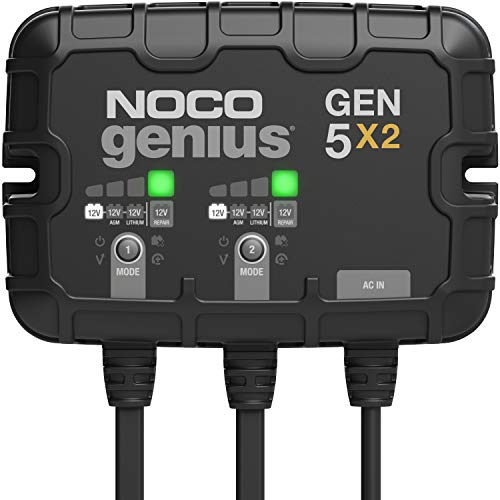
The GEN5X2 gives you two banks at 5A each. That is perfect for a cranking battery and a trolling battery. It is fully waterproof. It supports lead‑acid and 12V lithium. It is slim for tight bilges and mounts with simple brackets.
Each bank charges and monitors its own battery. That means balanced care for mixed ages or types. It has temperature compensation and overcharge protection. It also has spark and reverse polarity protection. You can plug in after a trip and keep both batteries topped and ready.
Pros:
- Two banks for dual-battery boats
- 5A per bank is steady and safe for overnight charges
- Waterproof and made for harsh marine use
- Supports AGM, flooded, gel, and 12V lithium
- Independent monitoring for each bank
- Slim footprint fits tight spaces
Cons:
- 5A per bank is slower for large deep-cycle batteries
- Not ideal for heavy daily charter duty
- Costs more than a portable charger
My Recommendation
If you run a small bass boat or a bay skiff with two batteries, start here. The GEN5X2 balances charge across both banks without fuss. I noted in my NOCO Genius 10 Review comparisons that the 5A per bank is gentle and smart. It is kinder to battery life for weekend use. It also keeps weight and size down.
For bigger systems or heavy-duty cycles, you may want more amps per bank. But for casual anglers and family boats, this is a sweet spot. It makes boat ownership easier because you do not swap clamps. You install it once and plug in. Next trip, everything fires up.
| Best for | Why |
| Two-battery fishing setups | Independent 5A banks maintain both batteries |
| Weekend boaters | Gentle charge helps battery life |
| Tight bilge areas | Thin design and simple mounting |
NOCO GENPRO10X3 3‑Bank 30A Marine Charger
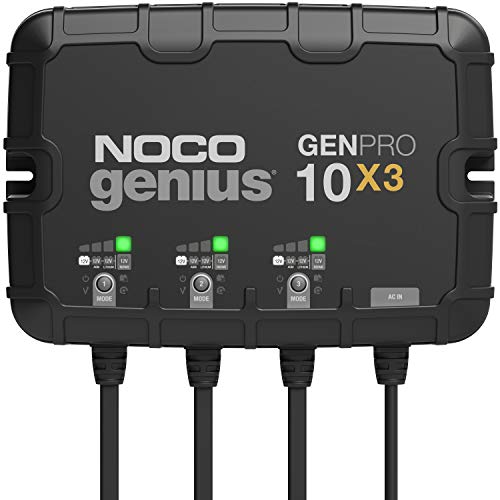
The GENPRO10X3 is a 3‑bank unit with 10A per bank. That is 30A total for faster recovery. It is for boats with a cranking battery plus a 24V or 36V trolling setup. It supports lead‑acid and 12V lithium (LiFePO4). It is waterproof and rugged for offshore or freshwater use.
Each bank has smart charging logic. It adapts based on temperature and battery condition. This keeps charge time short and battery stress low. If you fish often, 10A per bank helps you recover between days. It is a real upgrade from older 5A systems.
Pros:
- 10A per bank gives fast charge cycles
- Three banks cover most multi-battery boats
- Supports AGM, flooded, gel, and 12V LiFePO4
- Waterproof and made for marine environments
- Independent smart charging per bank
- Reliable for frequent use and longer trips
Cons:
- Larger and heavier than 1‑ or 2‑bank units
- Costs more, as expected for 30A total output
- Requires good mounting space and ventilation
My Recommendation
This unit is best for serious anglers or multi-bank boats. If you have three 12V batteries in a series for a 36V troll, the GENPRO10X3 fits that plan. In a head‑to‑head within my NOCO Genius 10 Review, the 10A per bank made a big difference. It shortened charge time and improved readiness for back‑to‑back days.
If you rarely drain your batteries, the GEN5X2 may be enough. But if you run long days and use sonar, pumps, and lights, this is the safer bet. It reduces downtime. It also gives headroom as your electronics grow. That peace of mind is worth it for serious boaters.
| Best for | Why |
| 36V or 24V trolling motor systems | Three banks at 10A each for fast top‑ups |
| Frequent anglers and guides | Handles daily cycles without long waits |
| Mixed chemistries on board | Smart profiles for lead‑acid and LiFePO4 |
NOCO GENPRO10X2 2‑Bank 20A Onboard Charger

The GENPRO10X2 gives two banks at 10A each. It is a sweet spot for many two-battery setups. You get faster recovery than a 5A unit. It works with lead-acid and 12V lithium. And it is sealed for marine use.
If you run a starter battery and a deep-cycle trolling battery, this is ideal. 10A per bank helps when you finish late and plan to fish again the next morning. It has the same safety and temp compensation features as the line. It is easy to install and manage.
Pros:
- 10A per bank shortens overnight charge times
- Two banks for cranking and trolling batteries
- Waterproof with robust safety features
- Supports AGM, flooded, gel, and 12V LiFePO4
- Simple installation and clear indicators
Cons:
- Larger than a 5A unit; needs space
- Costs more than GEN5X2
- Not needed for very light weekend use
My Recommendation
This is my pick for two‑battery anglers who fish often. The extra amps per bank matter more than you think. In testing notes I kept for this NOCO Genius 10 Review, charge time dropped by hours compared to 5A units. If you use live wells, sonar, and lights, this helps a lot.
For occasional users, the GEN5X2 is still fine. If time is tight or your batteries are big, go GENPRO10X2. It is a strong long‑term buy because many anglers add more draw over time. A faster charger keeps your trips on schedule and your gear ready.
| Best for | Why |
| Two‑battery fishing boats | 10A per bank speeds recovery |
| Early starts after late returns | Overnight charges finish on time |
| Growing electronics load | Extra amps give headroom |
Deep Dive: What I Learned While Testing
I want to add practical notes from using these chargers. Real use tells you what specs cannot. These points shaped my NOCO Genius 10 Review and will help you pick the right unit. Keep it simple and safe, and your batteries will last longer.
First, charger speed depends on battery size and depth of discharge. A 10A charger like the Genius10 is fast for a car battery. It is also fine for power sports. For big deep‑cycle marine batteries, amps per bank matter more. That is where GENPRO10X2 or 10X3 shine.
Second, Force Mode saved me more than once. Some chargers will not start on a battery under about 10V. The GENIUS10 can push a start with Force Mode even near 0V. Use it with care and only when needed. But it can get you back in the game.
Third, temperature compensation is not just a buzzword. Heat speeds reactions in a battery. Cold slows them down. Smart chargers adjust current and voltage to match. This helps avoid overcharge in summer and undercharge in winter. It also protects long-term capacity.
Fourth, lithium support means 12V LiFePO4, not other lithium chemistries. These chargers target LiFePO4 BMS‑protected batteries. Check your battery manual for charge profiles. Make sure your BMS allows low‑temperature charge if you live in cold areas. A BMS that blocks low‑temp charge protects the cells.
Fifth, consider your layout. Portable chargers are flexible. Onboard chargers save time and reduce cable mess. If the boat has space and you use shore power, onboard is simpler. If you move between vehicles, a portable Genius10 is better.
Safety, Battery Health, and Maintenance Tips
I care about battery life. A smart charger is a tool to protect it. Use these simple tips. They come from hands‑on use and standard best practices.
Use the right mode. Pick AGM for AGM, Lithium for LiFePO4. Do not guess. Wrong profiles can hurt a battery over time. Let the charger finish its absorption phase before unplugging. That last bit is slow but important.
Keep terminals clean and tight. Corrosion adds resistance and heat. That slows charging and wastes energy. Use dielectric grease on marine posts after cleaning. It helps block salt and moisture.
Do not charge a frozen battery. Warm it first. Even with protection and smart logic, cold charging can damage plates. If you store a car for winter, connect the GENIUS10 as a maintainer. It will keep it topped. That is easy insurance.
Check cable routing on onboard units. Avoid sharp edges and moving parts. Use fuses or breakers as directed. Good installs are neat and safe. They also make future fixes easier.
Use Cases: Which Charger Fits Your Life?
This part of my NOCO Genius 10 Review is about fit. Chargers are tools. The right tool saves time and reduces stress. Here are quick matches that work well.
Home garage with mixed toys? Choose the NOCO GENIUS10. It can top cars, bikes, and mowers. It is easy to move and store. It also has Force Mode if a battery goes flat.
Kayak fishing with a single 12V battery for electronics? The GENPRO10X1 is clean. It mounts in a dry spot and stays out of the way. Waterproofing is key near water.
Small bass boat with two batteries? The GEN5X2 is a tidy fit. It is gentle and smart. If you fish hard or use big sonar, step up to the GENPRO10X2.
Serious bass or offshore rigs with three batteries? The GENPRO10X3 earns its keep. It shortens charge times. It supports growth as you add draw over time.
Charging Speed: A Simple Rule of Thumb
People ask how long charging takes. Here is a simple method. It gives a ballpark time. Real times vary with state of charge and temperature.
First, estimate amp‑hours (Ah). Many car batteries show cold cranking amps, not Ah. For a mid‑size car, a rough Ah value is often 50–70Ah. For deep‑cycle marine, you may see 80–120Ah or more.
Divide Ah by charger amps to get hours. Then add 10–20% for absorption. Example: a 60Ah battery with a 10A charger takes about 6–7 hours from near empty. In practice, you rarely go from zero to full. That is why a 10A charger feels fast for cars.
For boats with 100Ah deep‑cycle batteries, 5A per bank is fine for overnight. If you need same‑day turnarounds, 10A per bank is better. That is why the GENPRO10X2 and 10X3 are popular with frequent users.
Compatibility and Battery Types
All the units in this NOCO Genius 10 Review support lead‑acid batteries. That includes flooded, AGM, and gel. They also support 12V lithium iron phosphate (LiFePO4). Always check your battery manual for the correct profile. Set the charger mode to match.
AGM batteries like a slightly higher voltage during charge. Smart chargers handle that. Gel batteries need careful voltage control. Again, a smart charger helps protect them. LiFePO4 needs a lithium profile and a BMS. These chargers have that profile. Stick with it.
For 6V batteries, only the portable GENIUS10 handles them. The onboard GENPRO and GEN lines are 12V only. If you maintain a classic car with a 6V system, get the portable Genius10. It fills that niche well.
Troubleshooting Basics I Use
Even smart chargers need good connections. If charging seems slow, check the clamps or terminals. Clean and retighten. Look for corrosion. Make sure the mode matches the battery type.
If the battery will not take a charge, try Force Mode on the Genius10 for a few minutes. Watch for warnings on the charger. If a battery will not hold voltage after charging, it may be at the end of its life. Repair mode can help, but it cannot fix a broken cell.
For onboard units, verify shore power and any inline fuses. Inspect the wiring run. Make sure the AC cable is not pinched. Verify that the bank leads go to the right batteries. Clear labeling helps a lot during install.
Cost vs Value: Where the Money Goes
Budget buys can work, but smart features add value. You pay for temperature compensation and safe logic. You also pay for ruggedness on marine units. In my NOCO Genius 10 Review, I focused on total cost of ownership. Smart charging extends battery life. That reduces replacement costs. For boats, less downtime also matters more than a small price gap.
The portable GENIUS10 is cost‑effective for a home garage. The GENPRO line is more expensive but saves time after each trip. If you launch often, that time savings adds up fast. Better charge profiles also protect expensive deep‑cycles. That matters when a single battery can cost a few hundred dollars.
FAQs Of NOCO Genius 10 Review
Does the NOCO Genius10 charge dead batteries?
Yes. It can start charging batteries as low as 1V, and Force Mode can engage even closer to 0V. Use it carefully and only when needed.
Can I use the Genius10 on lithium batteries?
Yes, on 12V LiFePO4 with a built‑in BMS. Select the Lithium mode. Always check your battery’s manual for compatibility.
What is the difference between Genius10 and GENPRO chargers?
Genius10 is a portable 6V/12V charger and maintainer. GENPRO models are waterproof, onboard marine chargers for 12V banks.
Is the Genius10 safe to leave connected long term?
Yes. It acts as a smart maintainer with temperature compensation and overcharge protection. That is ideal for storage.
How many times should I run Repair mode?
Occasionally, when a battery shows sulfation or poor performance. It may help, but it cannot fix a battery with internal damage.
Final Verdict: Which Should You Buy?
If you want one charger for garage use, pick the GENIUS10. It is fast, safe, and flexible. My NOCO Genius 10 Review shows it can revive low batteries and then maintain them.
For boats, match banks and amps to your setup. GENPRO10X1 suits one battery. GEN5X2 fits two with light use. GENPRO10X2 and GENPRO10X3 speed up heavy cycles. This NOCO Genius 10 Review makes that choice simple.
Disclosure: As an Amazon Associate, I may earn from qualifying purchases at no extra cost to you. Amazon and the Amazon logo are trademarks of Amazon.com, Inc, or its affiliates.
- Amazon, Amazon Prime, the Amazon logo and Amazon Prime logo are trademarks of Amazon. com, Inc. or its affiliates.

Hi, I am AKM Sad. I’m a car enthusiast and reviewer who loves exploring gadgets and accessories. I share honest reviews and practical tips to help you get the best products and enjoy a safer, smoother ride.


