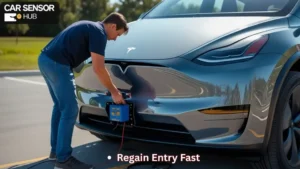
Open Controls, set cold PSI to 42, hit Reset Sensors, then drive 10–20 minutes.
If your dash shows a TPMS alert, don’t panic. I work with Tesla owners each week, and this Tesla Model Y tire pressure sensor reset guide is the simple fix that keeps your car safe and smooth. In this guide, I will show you clear steps, why they work, and the pro tips I use myself after rotations, wheel swaps, or cold snaps.
How the Model Y tire pressure system works
The Model Y uses Bluetooth Low Energy sensors in each wheel. The sensors read pressure and temperature and send data to the car. The system auto learns sensors after service or a wheel swap. You still need to reset the system in the menu and take a short drive so it can relearn correctly. This Tesla Model Y tire pressure sensor reset guide explains that full flow.
Before you reset: set correct cold tire pressure
Start with the basics. Set your tires to the recommended cold pressure. For most Model Y trims and wheel sizes, Tesla recommends 42 psi cold. Always verify the sticker on the driver’s door jamb. It lists the right pressure for your build and load.
Check pressure when tires are cold. That means the car has sat for three hours, or you have driven less than one mile. Temperature swings change pressure by about 1 psi for every 10°F. If a cold front hits, expect a drop. Top off air first, then follow this Tesla Model Y tire pressure sensor reset guide.
Tools that help:
- A quality digital gauge that reads to 0.5 psi
- A 12V inflator that can reach 50 psi
- Soapy water for quick leak checks on valve stems
Pro tip from the field. The Tesla app can show tire pressures, but only while the car is awake and driving. Use a handheld gauge for the cold set. Then confirm readings in the app on your next drive.
Read More: How to Reset the Tire Pressure Monitoring System
Step-by-step Tesla Model Y TPMS reset guide
Here is the exact process I use on my Model Y and on customer cars. Software labels can change a bit over time. The core steps are the same. This Tesla Model Y tire pressure sensor reset guide works after rotations, wheel swaps, or sensor replacement.
Step 1. Set cold tire pressure
- Inflate or deflate all four tires to the placard value. For most cars, that is 42 psi cold.
- If you have a spare set of wheels, match all four first. Then check again after a short drive.
Step 2. Use the in-car reset
- On the touchscreen, go to Controls, then Service.
- Look for Wheel & Tire or Tire Pressure. Tap Reset TPMS sensors or Reset Sensors.
- If you changed wheel size or style, tap Wheel Configuration. Select the correct wheel. Save and exit.
- The label can vary by software version. If you cannot find it, use the search bar in Controls and type tire.
This step anchors our Tesla Model Y tire pressure sensor reset guide. It tells the car to forget old sensor IDs and start a new learn.
Step 3. Drive to complete learning
- Drive 10 to 20 minutes at 25 to 50 mph.
- Keep speed steady when you can. Avoid long stops during the learning phase.
- Watch for the TPMS alert to clear. Pressures should appear for all four wheels.
This drive is the heart of any Tesla Model Y tire pressure sensor reset guide. The car needs motion and time to pick up each sensor.
Step 4. Verify and fine tune
- After the drive, park and let the tires cool.
- Recheck cold pressures next morning. Adjust if needed.
- The system shows live pressures while driving. Small swings are normal as tires warm up.
Real-world note. When I switch to winter wheels with new BLE sensors, the car learns them in about 8 minutes on a 35 mph road. On a cold day, it can take closer to 15 minutes.

Source: youtube.com
Troubleshooting TPMS errors on Model Y
If the alert stays on, do not assume the sensor is bad. Work the list. This Tesla Model Y tire pressure sensor reset guide includes the checks that solve most cases fast.
Common fixes:
- Wrong pressure: Set to the door-jamb value. Too low or too high can keep the light on.
- Incomplete drive: Repeat the 10 to 20 minute drive above 25 mph.
- Software update: Install any pending update. Then repeat the reset and the drive.
- Wheel size mismatch: Confirm Wheel Configuration matches your wheels.
- Interference: Move away from heavy Wi‑Fi or strong radio sources. Then retry the learn.
Check for leaks if pressure drops overnight:
- Spray soapy water on valve stems and around the bead. Watch for bubbles.
- Check caps and cores. A loose core can leak slowly.
When a sensor may be bad:
- One wheel shows no reading after multiple drives.
- You see “Tire pressure monitoring system fault.”
- The car never completes a learn after a reset.
If a sensor failed, ask for BLE sensors that match Model Y. Avoid old 433 MHz sensors. After install, repeat the Tesla Model Y tire pressure sensor reset guide and the learn drive.
Read More: How to Reset Tesla Model Y Screen
Pro tips for accuracy, safety, and tire life
These are habits I teach owners. They cut noise, improve range, and protect tread. They also make any Tesla Model Y tire pressure sensor reset guide more effective.
- Set pressures at ambient morning temps. Heat from sun or a recent drive gives false highs.
- Expect a rise of 3 to 5 psi when hot. Do not bleed air from hot tires.
- For heavy loads or long highway trips, aim for the high end of the placard range if shown.
- Rotate every 6,250 to 7,500 miles. Do the reset after each rotation.
- After curbing a wheel, recheck pressure and sensor health the same day.
- Winter swings are real. Set a reminder to check monthly. Add air when temps drop.
If you run aftermarket wheels:
- Use BLE-compatible sensors. Ask your shop to confirm Tesla compatibility.
- Match wheel size in Wheel Configuration to keep speed and range estimates accurate.
- Relearn after install using this Tesla Model Y tire pressure sensor reset guide.

Source: pimpmyev.com
When to see a pro and what it may cost
Some fixes need tools. That is normal. Here is when I send owners to a tire shop or Tesla Service.
- A sensor will not read after two reset-and-drive cycles.
- You see repeated TPMS faults across multiple drives.
- You find a bead leak or cracked valve stem.
- You changed wheels and are unsure about sensor type.
Typical costs in my area:
- BLE sensor and install: 50 to 100 dollars per wheel.
- Valve stem or core service: 10 to 30 dollars per wheel.
- Leak repair: 25 to 40 dollars.
A good shop will test the sensor battery and signal. Ask them to perform the reset. Then do the learn drive. You can finish with the steps in this Tesla Model Y tire pressure sensor reset guide.
Essential Tools for Tesla Model Y Owners
Maintaining the correct tire pressure (TPMS) on your Tesla Model Y is not just about clearing a dashboard warning; it’s about preserving your driving range and protecting your battery. Since the Model Y has specific requirements, these essential tools are must-haves for every owner:
1. Portable Tire Inflator (12V or Battery Powered)
The Model Y requires a high tire pressure of 42 PSI. Gas station pumps are often inaccurate or out of service. A compact, portable air compressor like the Fanttik X8 Apex or Xiaomi Portable Electric Air Compressor allows you to top off your tires anywhere, ensuring your TPMS sensors stay happy and your efficiency remains high.
2. Tesla-Specific Jack Pads
You should never lift a Tesla without these. Because the massive battery pack sits at the bottom of the chassis, using a standard floor jack can cause thousands of dollars in damage. These rubber Jack Pads fit into the specific lift points of your Model Y, providing a safe cushion whenever you need to swap tires or inspect a faulty sensor.
3. Bluetooth (BLE) TPMS Sensors
If your Model Y was manufactured in 2021 or later, it uses Bluetooth Low Energy (BLE) sensors. Unlike older radio-frequency sensors, these are specific to Tesla. If you are upgrading to aftermarket wheels or replacing a damaged unit, ensure you get the correct BLE sensors to avoid persistent “TPMS Fault” warnings on your touchscreen.
4. High-Accuracy Digital Tire Pressure Gauge
While the Tesla app and touchscreen provide real-time data, a manual check is the only way to verify if a sensor is malfunctioning. A high-quality digital gauge helps you confirm the exact PSI before performing a manual TPMS reset through the Service menu.
5. Emergency Tire Repair & Plug Kit
Tesla does not include a spare tire. If your TPMS alerts you to a rapid pressure drop due to a nail or screw, a heavy-duty Tire Repair Kit (like those from Boulder Tools) or a tire sealant kit can save you from an expensive tow truck bill and get you safely to the nearest service center.
Pro Tip: Keeping these tools in your sub-trunk or frunk ensures that you are prepared for any tire-related issues, helping you maintain optimal safety and vehicle performance.
TPMS Reset Requires Precise Tire Pressure!
BEST TESLA Y PORTABLE TIRE INFLATOR →
*Maintain the perfect 42 PSI for maximum range*
Final Tone
A clean reset is quick. Set the right cold PSI, tap Reset Sensors, and take a short drive. You will clear warnings, save tread, and protect range with a few simple habits. Keep this Tesla Model Y tire pressure sensor reset guide handy for rotations, seasonal swaps, and new tires. Try the steps today, then share your results or questions so others can drive with confidence and learn from your experience.
You May Like This Guide: What TPMS sensor kit is compatible with Tesla Model Y
FAQs Of Tesla Model Y TPMS Reset Guide
What is the recommended tire pressure for the Model Y?
Most Model Y cars use 42 psi cold for all four tires. Check the driver’s door jamb sticker to confirm your exact number. Best TPMS Sensors for Tesla Model Y
Do I need to reset TPMS after rotating tires?
Yes. Use Controls, Service, and Reset Sensors. Then take a 10 to 20 minute drive so the car relearns positions.
How long does the relearn take after a reset?
Plan for 10 to 20 minutes above 25 mph. Keep a steady speed to help the system lock onto each sensor.
Can I see tire pressures in the Tesla app?
Yes, while the car is awake and driving. The app shows the latest readings, but set cold pressure with a handheld gauge.
What if I installed aftermarket wheels?
Make sure you have BLE-compatible sensors. Update Wheel Configuration in the Service menu, reset sensors, and do the learn drive.
Why does my TPMS light come on in cold weather?
Cold air lowers pressure. Expect about 1 psi drop for every 10°F. Add air to reach the cold spec and reset if needed.
Can I mix old TPMS sensors with new BLE sensors?
No. Model Y uses BLE sensors. Use BLE sensors on all four wheels to ensure proper function.
Disclosure: As an Amazon Associate, I may earn from qualifying purchases at no extra cost to you. Amazon and the Amazon logo are trademarks of Amazon.com, Inc, or its affiliates.
- Amazon, Amazon Prime, the Amazon logo and Amazon Prime logo are trademarks of Amazon. com, Inc. or its affiliates.

Hi, I am AKM Sad. I’m a car enthusiast and reviewer who loves exploring gadgets and accessories. I share honest reviews and practical tips to help you get the best products and enjoy a safer, smoother ride.