There’s no single best cordless soldering iron for car repairs. The right one comes down to three things: how you’ll power it, how long a job runs, and how much heat the work needs. Two products split most buyers: the Fanttik T1 Max for battery work with a stand, and the LEXIVON Butane Soldering Iron for jobs where a flame does more than solder.
1. Fanttik T1 Max Soldering Iron Kit

Best for: someone who wants one iron for dash and harness work.
Car wiring hides behind panels, under seats, and inside looms. That kind of job rewards an iron you can hold in one hand with no cord dragging across the seat. The T1 Max runs on a built-in 2600mAh battery, so it works away from an outlet. In wireless mode the listing states a maximum DC output of 12W for up to 60 minutes at 840°F.
Its four C210 tips cover the shapes car work keeps asking for. The listing says heating takes 7 seconds, which matters when you’re on your back with one hand free. Six temperature levels run from 390°F to 840°F, so you can back off the heat near plastic connectors and push it up on thicker wire.
The gravity sensing is the detail that changes daily use. Stop for 30 seconds and it sleeps; pick it up and it returns to your set temperature. That saves the battery on a job that keeps getting interrupted. The aluminum stand holds the iron and stores tips in its base tray.
Good if:
- You do electrical repairs in tight spots, away from an outlet
- You want a stand that keeps the iron off the carpet and the seat
- You like setting a temperature and forgetting it
Skip it if:
- You need to solder heavy cable or thick ground straps all day
- You want a kit with solder, a pump, and tweezers already in the box
2. Soldering Iron Kit Cordless Portable 3200mAh Battery USB Rechargeable

Best for: someone who wants a single purchase to cover the whole job.
A first-timer buying for car repairs usually owns none of the small stuff — no solder, no pump, no tweezers. This kit lists 14 pieces: the iron, three C210 tips, a desoldering pump, 20g of lead-free solder wire, tweezers, a USB-C cable, two sponges, a stand and base, a manual, and a tool box. That’s a repair session in one purchase.
A 3200mAh battery with up to 60 minutes at 932°F in wireless mode. It also names a wider range than the Fanttik — 392°F to 932°F — with adjustment in 5℃ steps on an LED screen. Higher heat helps on thicker wire and older solder joints.
Two habits stand out. The square body sits on a flat surface without rolling, which matters on a driveway. And the listing says it powers off after 10 minutes of no operation, so a forgotten iron doesn’t sit hot in a footwell.
Good if:
- You’re building a car-repair kit from nothing
- You want the highest listed temperature and fine 5℃ steps
- You like a screen that shows the number, not a knob position
Skip it if:
- You already own solder, a pump, and tweezers
- You want a metal-bodied tool rather than engineering plastic
3. LEXIVON Butane Soldering Iron Multi-Purpose Kit

Best for: someone working where no outlet or charger will reach.
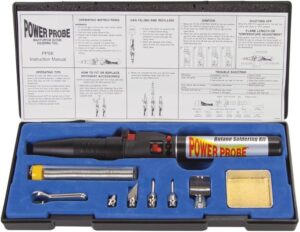
Some car jobs happen nowhere near power — a trailer harness in a field, a ground repair in a cold garage, a heat-shrink splice on a bumper. This is a butane torch kit, not a battery iron. It self-ignites with a trigger and locks the flame on, so you’re not holding a button down while you work.
A flame adjustable from 1/2″ to 2 1/2″, with working temperature up to 2400°F, or up to 1100°F with soldering tips fitted. That heat range covers more than soldering, so it suits car work where the listing notes you can shrink tubing on the same job.
The 100% metal refillable tank runs up to 75 minutes and refills in 10 seconds. Note the seller’s own warning: butane isn’t included, so you buy gas separately before the first use.
Good if:
- You work outdoors, in a cold garage, or far from power
- You want a single tool that handles soldering, heat shrink, and light torch work
- You’d rather refill in seconds than wait on a charge
Skip it if:
- You want a tool that’s ready straight out of the box
- You’re only doing delicate work on thin wiring
4. Livemon Cordless Soldering Iron

Best for: someone doing fine work in dark, cramped spaces.
Under-dash work is dark and tight, and that’s where this iron aims. An LED sits right at the tip, lighting the joint you’re actually soldering rather than the whole footwell. 75W of output and heat-up in 5 seconds.
Temperature adjusts from 365°F to 896°F, and you set the auto-sleep period yourself instead of living with a fixed one. An IPS color screen shows real-time temperature and status, which reads clearly in a bright garage or a dim one. That combination suits small connectors and thin wire where too much heat damages what’s around the joint.
The body is CNC machined aluminum with a high-temperature silicone grip. Tips swap without tools, and the listing offers two charging routes: a magnetic stand or a direct Type-C cable. The stand is the trade-off to weigh — it’s a charging base, not a full work stand.
Good if:
- You solder small connectors and thin wire in low light
- You want the fastest listed heat-up and a visible temperature readout
- You want to set your own sleep timing
Skip it if:
- You need a wide stand with storage for a busy bench
- Your work is heavy cable and thick lugs
5. Weller 6W/8W Cordless Soldering Iron

Best for: someone who wants the simplest possible tool.
Not every car repair needs a temperature screen. Sometimes you need to fix a single broken wire and put the tool away. This Weller runs on AA batteries, so there’s no charging routine and no cable — you swap cells and keep going, and the listing names 38-second heat-up.
6W/8W output, so it’s a light-duty iron for small wire and quick joints. It also lists a bright LED for low-light work, and an automatic shut-off into a locked position when the cap is closed. That last detail is the safety feature that matters when the iron lives in a glovebox or a door pocket.
For a buyer who wants a known name and a simple routine, that’s the whole pitch.
Good if:
- You want no charging routine and no cable at all
- You do occasional small electrical fixes
- You want a tool that locks off when capped
Skip it if:
- You solder regularly or work on thicker wire
- You want adjustable temperature control
Also Worth Considering
The Berkling Tools BSG-568 Soldering Iron is a butane 3-in-1 — soldering iron, heat gun and micro torch in one self-igniting tool, with an adjustable flame, a listed 90-minute runtime and a 20-second refuel. If you want torch capability and a longer listed run than the LEXIVON, this is the one to compare against it.
The Larlarsa Cordless Soldering Iron Kit is a USB-C rechargeable soldering pen with a 1100mAh battery and an LCD screen. It’s aimed at electronics repair and hobby work, so treat it as a light-duty option for small wiring rather than a main car-repair iron.
The CCMADE Portable Cordless Soldering Iron is a USB-C pen with an LED display, a 510 universal connector, and three-temperature ceramic heating. It’s built for circuit boards, phone repair and DIY projects, which puts it in the same light-duty bracket as the Larlarsa.
Where These Overlap
The Fanttik T1 Max and the Beizkna are close cousins. Both use C210 tips, both run a battery with a wired Type-C fallback at the same listed 16W AC output, both sleep after 30 seconds, and both list up to 60 minutes of wireless runtime. The Beizkna names a bigger battery and a wider temperature range; the Fanttik names a faster heat-up and a stand with tip storage. Between those two, pick on the stand and the kit contents, not on performance.
The Livemon and the Beizkna overlap on the essentials too — both heat in about 5 seconds. The real split is elsewhere. The LEXIVON and the Berkling sit in their own category entirely: butane tools that also run as torches, for work a battery iron can’t reach.
Still Not Sure?
How often will I actually use a cordless soldering iron for car repairs?
Be honest about frequency. If it’s a few joints a year, the Weller WLIBAK8 covers small wire with no charging routine. If you’re rewiring a project car, the Fanttik T1 Max earns its place with six temperature levels and a stand that keeps the iron ready between joints.
Will it work with the wire and connectors already in my car?
Most automotive wiring is thin, and all five main picks handle it. Thicker cable and ground straps are where the split shows: the LEXIVON Butane Soldering Iron lists up to 1100°F with soldering tips fitted, well above what the battery irons name. Match the tool to your heaviest joint, not your lightest.
What am I most likely to regret?
Buying a kit that can’t finish the job. The Beizkna comes with solder, a pump and tweezers, so nothing stalls you mid-repair. The LEXIVON needs butane bought separately before first use. Check what’s in the box before you start, because a missing consumable ends the session.
Frequently Asked Questions
Can I use a cordless soldering iron on car wiring?
Yes, for most automotive wiring. Thin wire and small connectors are well within range for all the battery irons here. The limit is heavy cable and thick ground straps, which pull heat away fast. For those, the LEXIVON Butane Soldering Iron lists up to 1100°F with soldering tips fitted, the highest soldering figure named here.
What temperature do I need for automotive wiring?
The battery irons here name ranges from 365°F up to 932°F. The Beizkna names the highest at 932°F, with 5℃ adjustment steps. For thin wire, lower settings protect nearby insulation. For thicker wire and older joints, the top of the range helps. Start low and work up rather than starting hot.
Do I need flux or extra solder with these kits?
It depends on the kit. The Beizkna includes 20g of lead-free solder wire, a desoldering pump and tweezers, so it covers a repair on its own. The Fanttik, Livemon and Weller listings don’t mention solder in the box, so plan to have your own. The LEXIVON needs butane, which the seller states isn’t included.
Is a butane soldering iron better than a battery one for car work?
Not better — different. Butane reaches higher temperatures and needs no charging, and the LEXIVON lists up to 75 minutes of runtime with a 10-second refill. Battery irons give you set temperatures and a screen, like the Beizkna’s 5℃ steps. If your work is outdoors or far from power, butane suits it. For bench and dash work, battery wins on control.
Conclusion
If you’re soldering behind the dash and want a stand, look at the Fanttik T1 Max. If your jobs happen away from any outlet, the LEXIVON Butane Soldering Iron is the one. Check the listing for what’s included, and for the details on the build and warranty.
Disclosure: As an Amazon Associate, I may earn from qualifying purchases at no extra cost to you. Amazon and the Amazon logo are trademarks of Amazon.com, Inc, or its affiliates.
- Amazon, Amazon Prime, the Amazon logo and Amazon Prime logo are trademarks of Amazon. com, Inc. or its affiliates.

I am Sadman, the founder of CarSensorHub.com, where I share my passion for cars and technology. I specialize in writing detailed reviews and helpful guides on car gadgets, accessories, safety tools and many more. My mission is to help car owners discover the best products and tips to improve their driving experience and stay safe on the road.