A dead car battery can happen at the worst possible time. You might be getting ready for work, leaving a shopping center, or preparing for a long road trip when your engine suddenly refuses to start. In that situation, two common solutions are traditional jumper cables and a portable jump starter.
Both can help restart a vehicle with a discharged 12-volt battery, but they work differently. Jumper cables transfer electrical power from another compatible vehicle or external booster battery. A portable jump starter carries its own rechargeable battery, allowing you to start a compatible vehicle without depending on another driver.
So, when comparing jumper cables vs jump starter devices, which option makes more sense for everyday drivers?
The answer depends on your driving habits, vehicle type, budget, emergency preparation, and how comfortable you are connecting battery terminals. This guide explains the differences, advantages, limitations, safety considerations, and products worth considering before you choose.
Are Jumper Cables Better Than a Portable Jump Starter?
A portable jump starter is generally more convenient for drivers who want to restart a vehicle independently without another car. Traditional jumper cables are a more affordable option if another compatible vehicle or 12V booster battery is available.
For most everyday drivers who frequently travel alone, carrying a properly rated portable jump starter is a practical choice. However, keeping a quality set of jumper cables as backup can provide additional flexibility.
Jumper Cables vs Jump Starter: What’s the Difference?
Before comparing their advantages and disadvantages, it helps to understand how each device works.
What Are Jumper Cables?
Jumper cables are insulated electrical cables with clamps at both ends. They connect a discharged vehicle battery to a compatible external power source, usually another vehicle’s battery.
The working vehicle supplies electrical current through the cables, helping the vehicle with the discharged battery start its engine.
Jumper cables do not generate electricity or store their own power. They depend on a suitable external power source and a safe connection procedure.
Most automotive jumper cables have two main conductors:
- Red cable: Connects to the positive (+) battery terminals.
- Black cable: Connects to the negative (-) terminal or an approved grounding point, depending on the vehicle manufacturer’s instructions.
Cable length, wire gauge, insulation quality, and clamp construction affect usability. Lower AWG numbers generally indicate thicker conductors. For many passenger vehicles, 4-gauge or 6-gauge cables are practical options, although the correct specification depends on the vehicle and cable manufacturer.
What Is a Portable Jump Starter?
A portable jump starter is a rechargeable battery-powered device designed to supply the electrical power needed to start a compatible vehicle with a discharged battery.
Most modern consumer models use lithium-based rechargeable batteries. They typically include heavy-duty clamps, charging indicators, safety protection systems, and a compact storage design.
Some models also offer additional features, including:
- Reverse-polarity protection.
- Short-circuit protection.
- USB charging ports.
- Built-in LED flashlights.
- Battery status displays.
- Overtemperature protection.
Unlike traditional jumper cables, a portable jump starter does not require another vehicle to supply starting power. However, the device must be sufficiently charged and compatible with the vehicle’s electrical system.
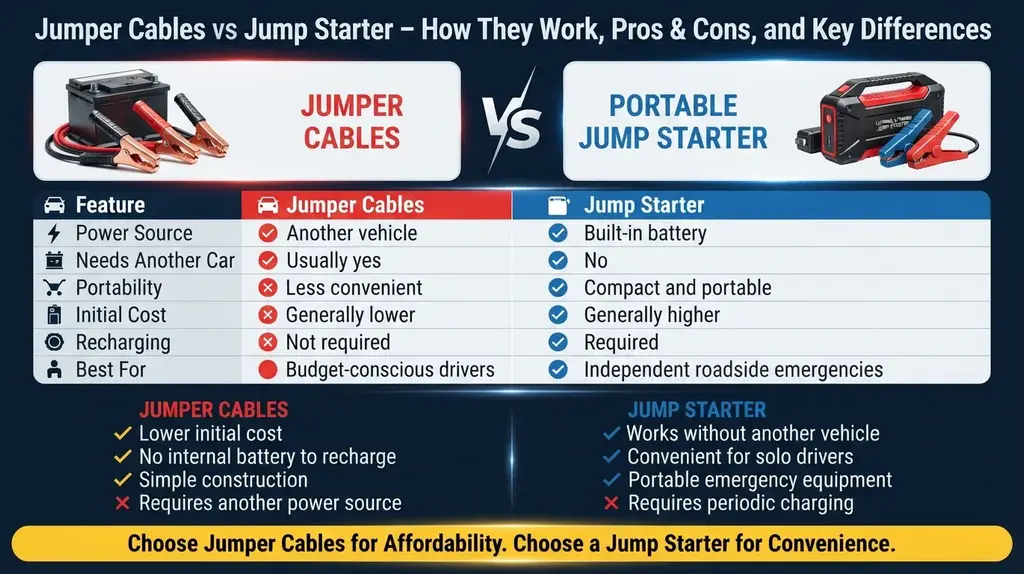
Jumper Cables vs Jump Starter: Side-by-Side Comparison
The following table highlights the most important differences between these two roadside emergency tools.
| Comparison | Jumper Cables | Portable Jump Starter |
|---|---|---|
| External vehicle required | Usually yes | No |
| Built-in battery | No | Yes |
| Charging required | No | Yes |
| Initial purchase cost | Generally lower | Generally higher |
| Independent operation | No, normally needs another power source | Yes, when adequately charged |
| Storage requirements | Minimal maintenance | Periodic charge checks |
| Setup requirements | Requires a donor vehicle and safe positioning | Requires compatible clamps and a suitable battery connection |
| Additional features | Generally none | May include USB ports and LED lights |
| Power limitations | Depends on the donor battery and cables | Depends on internal battery capacity and rated output |
| Best use case | Drivers with access to another vehicle | Drivers who want independent roadside assistance |
Advantages and Disadvantages of Jumper Cables
Traditional jumper cables remain useful even though portable battery technology has become more advanced. They are simple tools that can last for years when stored and maintained properly.
Advantages of Jumper Cables
- Affordable: A basic set generally costs less than a quality lithium jump starter.
- No internal battery: There is no built-in battery that needs periodic recharging.
- Long storage life: Properly stored cables can remain ready for use for many years.
- Simple construction: There are no electronic charging circuits or internal battery management systems.
- Useful as backup: They can help another motorist or be used with a suitable external booster battery.
Disadvantages of Jumper Cables
- Another power source is required: You normally need a second vehicle or suitable booster battery.
- Dependence on other drivers: Assistance may not be available in isolated locations.
- Correct connection matters: Incorrect connections can cause sparks, battery damage, or electrical problems.
- Parking position matters: The vehicles must be positioned safely and close enough for the cables to reach.
- Cable quality varies: Thin conductors and poor clamps can make starting more difficult.
Advantages and Disadvantages of Portable Jump Starters
Portable jump starters are designed to make roadside battery emergencies easier to handle. They are particularly useful for drivers who frequently travel alone or want an independent backup power source.
Advantages of Portable Jump Starters
- Independent operation: You do not need another vehicle to provide starting power.
- Convenient storage: Many lithium models are compact enough to store in a vehicle emergency kit.
- Quick access: A charged device can be connected without waiting for another driver.
- Additional features: Some models provide USB charging, flashlights, and battery displays.
- Useful for emergencies: They can be particularly helpful in remote areas where assistance may take time to arrive.
Disadvantages of Portable Jump Starters
- Charging is necessary: A depleted internal battery may not provide enough power to start a vehicle.
- Battery aging: Rechargeable batteries gradually lose capacity over time.
- Temperature limitations: Extreme heat or cold can affect charging and operating performance.
- Higher initial cost: Quality units generally cost more than basic jumper cables.
- Compatibility requirements: The unit must support the vehicle’s battery voltage and starting requirements.
Which Is Better for Different Driving Situations?
There is no single winner for every driver. The better option depends on where you drive, how often you travel, and whether you have access to roadside assistance.
1. For Drivers Who Travel Alone
A portable jump starter is usually the more convenient choice for solo drivers. If your car battery becomes discharged in an empty parking lot or on an isolated road, you can potentially restart your vehicle without waiting for another motorist.
Traditional jumper cables are less convenient in this situation because you still need another compatible power source.
Better choice: Portable jump starter.
2. For Long Road Trips
Drivers who regularly travel long distances should consider carrying appropriate roadside emergency equipment.
A portable jump starter provides independent starting power, while jumper cables offer an additional backup option if another vehicle is available.
For longer journeys, a complete emergency kit should also include a flashlight, reflective warning equipment, a first-aid kit, and other items suitable for the route and weather.
Better choice: Portable jump starter, with jumper cables as an additional backup.
3. For Drivers on a Tight Budget
If your main priority is spending as little as possible, a quality set of jumper cables may be the better starting point.
They can be useful for occasional battery emergencies, especially if you usually travel in populated areas where another compatible vehicle is likely to be available.
Better choice: Jumper cables.
4. For Cold Weather Driving
Cold temperatures can reduce a vehicle battery’s ability to deliver starting power. This can make winter battery emergencies more common.
A portable jump starter can be useful because it does not depend on another vehicle. However, its internal battery also has operating temperature limits.
Before winter, check the manufacturer’s temperature specifications and keep the jump starter charged. Do not assume that every lithium jump starter can be stored or operated in freezing conditions.
Jumper cables remain useful in winter if another suitable power source is available.
Better choice: A properly rated portable jump starter for independent use; jumper cables remain a useful backup.
5. For Multiple Vehicles at Home
If you own several vehicles or regularly help family members with battery problems, jumper cables can be a practical and economical option.
A suitable donor vehicle may already be available, making traditional cables convenient for occasional use.
A portable jump starter is still useful when vehicles are parked separately or when you do not want to move another vehicle into position.
Better choice: Both can be useful, depending on your household’s needs.
What Should You Look for When Buying a Portable Jump Starter?
Not every jump starter is suitable for every vehicle. Before purchasing one, compare its specifications with your engine and battery requirements.
1. Starting Current and Engine Compatibility
Manufacturers commonly advertise peak current ratings in amps. However, peak current alone does not establish whether a jump starter is suitable for your vehicle.
Check the manufacturer’s recommended gasoline and diesel engine capacities, supported battery voltage, and operating instructions.
2. Safety Protection
Look for protection against reverse polarity, short circuits, excessive current, and temperature-related problems.
Insulated clamps, clear warning indicators, and straightforward instructions are also useful features.
3. Battery Capacity and Recharge Time
A jump starter with a larger internal battery may provide more starting attempts under suitable conditions, but capacity alone does not determine starting performance.
Compare the battery’s watt-hour rating, starting specifications, and manufacturer’s stated recharge time.
4. Operating Temperature
If you live in a region with very cold winters or hot summers, check the manufacturer’s charging and operating temperature limits.
Never leave a lithium jump starter in an environment that exceeds its specified temperature range.
5. Cable and Clamp Quality
Check the length, insulation, conductor quality, and clamp design. A portable jump starter is only useful when its cables can safely reach the approved connection points.
Recommended Products Worth Comparing
If you decide that a portable jump starter is more suitable for your needs, the following products are worth researching. These are examples to help you compare different product types, not claims that they are the best products available for every vehicle.
Compact Lithium Jump Starter
NOCO Boost Plus GB40
The NOCO Boost Plus GB40 is a compact 12V lithium-ion jump starter designed for compatible gasoline engines up to 6.0 liters and diesel engines up to 3.0 liters.
Manufacturer-listed specifications:
- 1,000A peak current.
- 24Wh lithium-ion internal battery.
- 12V lead-acid battery compatibility.
- USB output for compatible personal devices.
- IP65 enclosure rating when port covers are closed.
Potential advantages:
- Compact and relatively lightweight design.
- Clear battery and status indicators.
- Built-in safety features.
Things to consider:
- It is designed for compatible 12V lead-acid starting batteries.
- Its rated engine compatibility must match your vehicle.
- It is a jump starter, not a replacement for a dedicated battery charger.
Who should consider it?
Drivers who want a compact, established-brand jump starter for compatible passenger vehicles may want to compare the GB40 with similar models. Check Latest Price on Amazon
Traditional Jumper Cables
CARTMAN 4-Gauge Jumper Cables
CARTMAN jumper cables are an example of the traditional cable-based approach. When comparing cable sets, look for suitable conductor gauge, sufficient length, durable insulation, and clamps that provide a secure connection.
Features to compare:
- 4-gauge cable configuration.
- Approximately 20-foot cable length on the referenced configuration.
- Clamps designed for battery terminal connections.
- Storage bag and additional accessories, depending on the package.
Potential advantages:
- No internal battery to recharge.
- Useful as an emergency backup.
- Can be used with a suitable donor vehicle.
Things to consider:
- Requires another compatible power source.
- Longer cables can be heavier and harder to store.
- Actual conductor quality and package specifications should be checked.
Who should consider it?
Drivers looking for a traditional emergency cable set at a relatively affordable cost may find this type of product practical. Check Latest Price on Amazon
Product specifications and package contents may vary by model or listing. Confirm the exact product configuration before purchasing.
Can You Keep Both Jumper Cables and a Jump Starter in Your Car?
Yes. In fact, carrying both can provide more flexibility during roadside emergencies.
A portable jump starter can help you restart a compatible vehicle without another car. Jumper cables can serve as an additional backup when a suitable donor vehicle or booster battery is available.
This combination can be particularly useful for drivers who travel long distances, own multiple vehicles, or regularly drive through areas with limited roadside assistance.
However, always store equipment according to its manufacturer’s instructions. Check the jump starter’s charge level periodically and inspect cables for damaged insulation, loose clamps, or corrosion.
How to Use Jumper Cables Safely
Incorrect jump-starting procedures can cause battery explosions, burns, electrical damage, or other serious injuries. Always consult the vehicle owner’s manual and follow its specific connection procedure.
A typical conventional 12V vehicle procedure involves the following steps, but the manufacturer’s instructions take priority:
- Park both vehicles safely, apply the parking brakes, switch off the engines, and turn off electrical accessories.
- Confirm that both vehicles use compatible 12V systems and that the batteries are suitable for jump-starting.
- Connect one red clamp to the discharged battery’s positive (+) terminal.
- Connect the other red clamp to the donor battery’s positive (+) terminal.
- Connect one black clamp to the donor battery’s negative (-) terminal.
- Connect the final black clamp to the designated ground point on the disabled vehicle, if specified by its manufacturer. Do not automatically connect it to the discharged battery’s negative terminal.
- Follow the vehicle manufacturers’ starting instructions. Do not allow cable clamps to touch each other or moving engine parts.
- After the engine starts, remove the cables in the reverse connection order, keeping the clamps separated.
Never attempt to jump-start a battery that is cracked, leaking, swollen, frozen, or otherwise visibly damaged. Do not use this general procedure for vehicles with special battery configurations unless their manufacturer explicitly permits it.
Hybrid and electric vehicles may have different procedures for their low-voltage systems. Consult the owner’s manual and use only approved jump-start points.
Common Mistakes to Avoid
- Using a jump starter that does not support the vehicle’s voltage or engine requirements.
- Connecting positive and negative clamps incorrectly.
- Ignoring the manufacturer’s designated grounding points.
- Trying to start a vehicle with a damaged or frozen battery.
- Using damaged or undersized jumper cables.
- Leaving a portable jump starter discharged for extended periods.
- Ignoring warning indicators or attempting to bypass safety protections.
- Assuming that a jump start will permanently repair a failing battery.
Which One Should You Choose?
The right choice depends on what you value most: convenience, affordability, independence, or backup flexibility.
| Your Situation | Recommended Option |
|---|---|
| You frequently drive alone. | Portable jump starter |
| You want the lowest initial cost. | Jumper cables |
| You regularly travel long distances. | Portable jump starter |
| You own multiple vehicles. | Both options can be useful |
| You want equipment without a rechargeable battery. | Jumper cables |
| You want independent emergency starting power. | Portable jump starter |
Our Verdict:
For most drivers who want a convenient and independent emergency solution, a properly rated portable jump starter is the more practical choice. It does not depend on another vehicle and can be especially useful when help is unavailable.
However, traditional jumper cables remain valuable because they are affordable, do not require charging, and can provide a reliable backup when another suitable power source is available.
If your budget allows, keeping both in your vehicle is a sensible way to prepare for different battery emergencies.
Frequently Asked Questions About Jumper Cables vs Jump Starter
Is a jump starter better than jumper cables?
A portable jump starter is generally more convenient because it can operate without another vehicle. Jumper cables are usually less expensive but require a compatible external power source. The better option depends on your driving habits and emergency needs.
Do jumper cables work without another car?
Traditional jumper cables normally require another vehicle with a suitable battery or another compatible external booster battery. They do not contain their own power source.
Can a portable jump starter start a completely dead battery?
A portable jump starter may start a compatible vehicle with a deeply discharged battery if the battery and vehicle are within the device’s operating limits. However, some units cannot detect or start extremely low-voltage batteries without a manufacturer-approved procedure. A physically damaged battery should never be jump-started.
Are jumper cables safer than portable jump starters?
Neither option is automatically safer in every situation. Both require correct connections and compatible equipment. Portable jump starters may include reverse-polarity and short-circuit protection, while traditional jumper cables depend heavily on proper connection technique and manufacturer instructions.
How long can a portable jump starter hold its charge?
Charge retention varies by battery chemistry, model, storage temperature, battery age, and usage. Follow the manufacturer’s charging and storage recommendations and check the charge level regularly.
Can I use jumper cables on a hybrid car?
Some hybrid vehicles permit a conventional 12V jump-start procedure, while others have specific connection points and restrictions. Always follow the vehicle manufacturer’s instructions. Never attempt to jump-start a hybrid’s high-voltage traction battery using ordinary jumper cables.
Should I keep a jump starter in my car during winter?
A portable jump starter can be useful during winter, but it must be stored within its manufacturer’s specified temperature range. Extreme cold can affect battery performance, and extreme heat can accelerate battery aging. Check the device’s charge before traveling.
Can jumper cables damage a car battery?
Incorrect connections, incompatible voltage, or failure to follow the recommended procedure can cause electrical damage or create dangerous conditions. Use compatible equipment and follow the instructions for both vehicles.
Final Thoughts
When comparing jumper cables vs jump starter devices, neither option makes the other completely unnecessary.
Jumper cables remain a simple and affordable emergency tool for drivers who have access to another suitable vehicle. Portable jump starters provide greater independence and convenience, particularly for solo drivers and people who regularly travel long distances.
Before choosing either option, consider your vehicle’s battery specifications, your driving environment, and your comfort level with roadside battery procedures.
For everyday convenience, a properly rated portable jump starter is worth considering. If you want a more complete emergency setup, keeping a quality set of jumper cables as backup can also make sense.
The most important thing is to prepare before a battery emergency happens, rather than trying to find equipment when your vehicle refuses to start.
Disclosure: As an Amazon Associate, I may earn from qualifying purchases at no extra cost to you. Amazon and the Amazon logo are trademarks of Amazon.com, Inc, or its affiliates.
- Amazon, Amazon Prime, the Amazon logo and Amazon Prime logo are trademarks of Amazon. com, Inc. or its affiliates.

I am Sadman, the founder of CarSensorHub.com, where I share my passion for cars and technology. I specialize in writing detailed reviews and helpful guides on car gadgets, accessories, safety tools and many more. My mission is to help car owners discover the best products and tips to improve their driving experience and stay safe on the road.


