A Nissan Qashqai parking sensor that suddenly stops working usually has a failed sensor, a wiring or ground fault, or a disabled parking assist system. Start with the safest checks: clean every sensor, note any warning message, and verify the relevant fuse. If the system still fails, scan for diagnostic trouble codes before replacing parts.
Key Takeaways
- Check warnings first. A “Parking Sensor” or “Around View Monitor” message can indicate system disablement or a stored fault.
- Clean every sensor. Dirt, mud, paint overspray, and ice can cause false readings or stop detection.
- Verify the fuses. A blown fuse is cheaper and simpler to fix than a failed sensor.
- Inspect for damage. Cracked sensor housings or bent brackets can interrupt the signal.
- Scan for codes. Diagnostic trouble codes can narrow the fault to a sensor, harness, or control unit.
- Stop if wiring smells hot. Melted insulation or exposed wiring requires professional diagnosis.
Why Nissan Qashqai Parking Sensors Stop Working
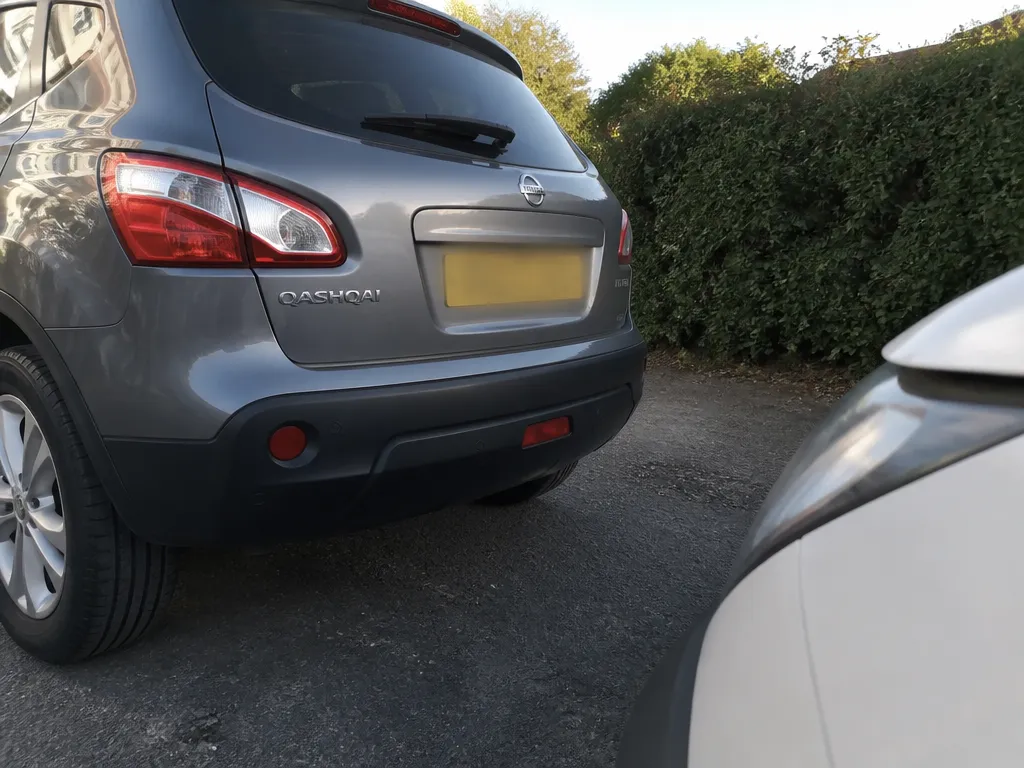
“Not working” usually means one of two things: the system produces no beeps, or it beeps intermittently, misses one side, or gives constant false warnings. Those patterns help identify the fault. Complete silence is more likely to involve a fuse, parking assist control issue, or system disablement than a single failed sensor.
Parking sensors share wiring and control logic with other driver-assist systems on many vehicles. A sensor fault may therefore appear as a generic “parking assist unavailable” message, while a fault in another assist system may also prevent the parking sensors from operating. Check whether the vehicle says the system is disabled before assuming the sensors need replacement.

Helpful pick
ApplianPar Front Parking Sensor for Nissan for Infiniti
If your system is experiencing complete silence, replacing a faulty sensor with this reliable unit can restore your parking assist functionality.
Diagnose the Failure Pattern
Treat the symptoms as clues. If the front sensors are silent but the rear sensors work, suspect a localized harness issue, a failed front sensor, or a front sensor circuit fault. If both front and rear sensors are dead, look first at shared power, a fuse, a ground, or a control module communication problem.
Note when the problem began. A parking-lot impact, bumper scrape, or recent detailing job makes sensor damage or misalignment more likely, even when the sensor looks intact. Heavy rain, winter ice, or off-road splash can move connector corrosion and sensor contamination higher on the list. A failure immediately after battery replacement, disconnection, or a jump start may involve a system relearn, a persistent fault that needs scanning, or a warning state that has not cleared.
A temporary disablement can also explain the failure. Some Qashqai variants may disable parking sensors after detecting a fault, when certain vehicle modes are active, or when another assist system has already reported a problem. First confirm whether the system is trying to operate or has shut itself down.

Helpful pick
NLQR Bumper Parking Assist Sensor Backup Reverse Sensor, Fit for Nissan Maxima Titan Altima Pathfinder, Fit for Infiniti 2014-2018, Replace 284383TA2E 284384DA1D 284383SH0B
Replacing a faulty individual sensor is often the first step when diagnosing a localized harness or circuit failure in your system.
Troubleshooting Steps in Priority Order

Start with a 10-minute cleaning and inspection because it is low-risk and often resolves false readings. Look for dirt, mud, film, ice, or paint overspray on each sensor face. Check every sensor for cracks, missing clips, or a crooked position in the bumper opening. If the bumper has dents near the corners, gently check whether a sensor bracket appears twisted.
Next, check the warning lights and messages. If the cluster or infotainment screen says “parking sensors” are unavailable, record the exact wording. Note whether the message appears immediately at startup or only when you shift into Reverse or drive forward at low speed. That timing can show whether the control unit is starting normally.
Check the fuses before buying parts. Turn the vehicle off, remove the relevant fuse or fuses, and confirm that they are intact. Replace a blown fuse only with one of the correct rating. If the replacement blows again, stop troubleshooting and have the vehicle inspected. A recurring blown fuse can indicate a short circuit or damaged wiring.
If the basic checks fail, read the vehicle’s diagnostic codes with a scan tool. A code such as “rear LH sensor circuit” can eliminate much of the guesswork. Basic OBD-II readers may not access the parking assist module, so use a tool that can read the correct vehicle system.
If live data is available, check whether the control unit receives sensor signals as you slowly move the vehicle near a solid object. If no sensor signals appear, the fault is more likely in the circuit, ground, or module than on the sensor face itself.
Stop immediately if you smell hot plastic, see melted insulation, or find an overheated or corroded connector. Improvised probing can turn a contained wiring fault into a larger electrical problem.
Use this symptom-to-check order:
- No beeps at all: Check the fuse and warning messages, then scan for control unit codes.
- Front sensors dead, rear sensors work: Clean the front sensors, inspect the front bumper for impact damage, and scan for front circuit codes.
- Rear sensors dead, front sensors work: Focus on the rear sensor faces, connectors, and rear harness routing.
- Intermittent beeps or false alarms: Clean the sensors thoroughly, check for harness movement near the bumper, and look for intermittent circuit codes.
- One sensor always gives the wrong reading: Clean and inspect the sensor housing, then replace that sensor only after codes confirm the fault.
What Repair Option Fits the Fault?
You have three sensible choices: handle low-risk checks yourself, use a scan tool for targeted testing, or have a shop diagnose the sensor and harness system.
A DIY approach is appropriate for cleaning, visual inspection, fuse checks, and using the vehicle’s warning messages to guide the next step. Avoid swapping sensors repeatedly without codes. Do not probe harness pins unless you can do so without shorting a circuit.
A scan tool makes DIY diagnosis more precise. A basic OBD-II reader may help, but parking sensor faults often require access to the vehicle’s parking assist module. If a code identifies a specific sensor circuit, you can test for continuity or shorts to ground in a controlled way, or ask a shop to perform that testing.
A shop is the lowest-effort option when no suitable scan tool is available, harness damage is suspected, or the vehicle has repeated failures. Ask for a code scan and sensor circuit testing rather than a “replace until it works” approach.
| Option | What you do | Best for | Typical risk level |
|---|---|---|---|
| DIY cleanup + inspection + fuse check | Clean sensor faces, inspect for damage, verify fuse | Intermittent or newly dirty sensors, obvious bumper impacts | Low |
| DIY with scan tool + targeted testing | Read codes, confirm sensor signal behavior, test circuits | Fault codes that name specific sensors or circuits | Medium |
| Shop diagnosis + repair | Code scan, sensor/harness testing, replace as needed | No codes available, harness damage suspected, repeated failures | Lowest for effort |
Match the Repair to the Sensor Pattern
If both front and rear sensors are dead, do not begin by replacing sensors. Check the shared power path, fuse, and grounds because both sides depend on them. If only one side is failing, focus on that sensor location, its connector, and the nearby harness.
A sensor that looks fine can still have an internal crack. Connectors can also develop corrosion that only becomes apparent when the harness moves. Diagnostic codes help show whether the control unit is receiving a sensor return at all.
When checking fuses, match the replacement rating to the original exactly. If the fuse blows immediately again, stop. That strongly suggests a short, and repeated attempts can overheat the wiring.
Use the correct replacement sensor for the vehicle’s exact year, bumper, and sensor style. Trim and bumper-package differences can affect sensor compatibility, and the wrong part may produce a persistent fault even after installation. If you are unsure, a shop can confirm the part number from the VIN.

Helpful pick
MOTOALL 28438-9UF1A Parking Sensor Fit for Nissan Frontier Murano Titan 2018-2024
Once you have isolated the faulty unit, this high-quality replacement sensor ensures your Nissan’s parking system returns to full functionality.
Common Nissan Qashqai Failure Scenarios
A common pattern is complete failure after a cleaning or detailing session. You shift into Reverse and hear no beeps. Residue or a film on the sensor faces may have changed how the system interprets distance, or a sensor may have been knocked out of alignment during bumper contact. Clean the sensors thoroughly and check for a cracked face. If a scan shows “sensor circuit open,” move on to wiring or sensor replacement.
If only the rear left sensor fails and the vehicle displays a rear sensor warning, clean that sensor and test whether the fault remains as you approach an object on the left side. If it does, scan for a rear LH sensor circuit code, inspect the rear connector for looseness or water intrusion, and replace the sensor only if circuit testing points to it.
Both front and rear sensors may go silent after a battery replacement, jump start, or extended low-voltage event. The parking assist system may refuse to operate while faults remain stored. Scan for codes, clear them when appropriate for the scan tool’s workflow, and retest. If the faults return immediately, investigate power, grounds, and the control unit.
A low-speed bumper tap can shift the bumper cover or push one sensor slightly out of position without leaving obvious damage. Intermittent beeps that change when the bumper moves often point to a loose connector or a harness rub point. Inspect the harness routing near the bumper edge before replacing the sensor.
Why Fixing the System Is Worthwhile
Working parking sensors reduce low-speed uncertainty in tight US parking lots, where curbs, shopping carts, and narrow spaces can be difficult to judge. Restoring the warning system also reduces the chance of bumper or wheel-arch damage.
A functioning system is also useful when you sell the vehicle or file an insurance claim after a parking incident. Persistent parking-assist faults may appear alongside other assist-system diagnostics, so resolving the original problem early can prevent additional troubleshooting later.
FAQ
Why did my Nissan Qashqai parking sensors suddenly stop working?
A dirty sensor face, an impact-damaged sensor, or a fuse or ground problem can cause sudden failure. Check for a parking sensor warning message and verify the relevant fuses before replacing parts. If the system says “unavailable,” use a scan tool to read parking sensor or parking assist codes.
Can I fix parking sensors not working on a Qashqai without a scan tool?
Sometimes. Clean the sensor faces, inspect for cracks or bumper misalignment, and check the correct fuses. If the vehicle still produces no beeps or shows a persistent error, a scan tool is the quickest way to identify the affected sensor circuit.
What is the safest quick test I can do at home?
Clean all sensors, then shift into Reverse and move the vehicle slowly near a solid object while observing whether the beeps are completely absent or missing on one side. If you find melted plastic, damaged wiring, or a fuse that blows again immediately, stop and seek expert help.
How much does it usually cost to repair Qashqai parking sensors?
The cost depends on whether the fault involves one sensor, a harness or connector, or a control module. A single-sensor replacement is usually cheaper than harness work, while a fuse or connector repair may cost less still. Get a code-based diagnosis before authorizing multiple parts.
What is the most common mistake when parking sensors stop working?
Replacing sensors without confirming which circuit failed is the most common mistake. A fuse or shared power or ground problem can make sensors appear faulty, so swapping them will not solve the root cause. Use the symptom pattern – front versus rear, left versus right, or complete silence – and read the codes when basic checks do not resolve the issue.
Disclosure: As an Amazon Associate, I may earn from qualifying purchases at no extra cost to you. Amazon and the Amazon logo are trademarks of Amazon.com, Inc, or its affiliates.
- Amazon, Amazon Prime, the Amazon logo and Amazon Prime logo are trademarks of Amazon. com, Inc. or its affiliates.

Hi, I am AKM Sad. I’m a car enthusiast and reviewer who loves exploring gadgets and accessories. I share honest reviews and practical tips to help you get the best products and enjoy a safer, smoother ride.