Many buyers looking for car welding robots get confused because the term covers two very different worlds. You might be hunting for an industrial machine for heavy manufacturing or a small kit to learn basic soldering at home. Buying the wrong type is the most common trap, but the mistake that’s hardest to undo is ignoring your specific power or assembly requirements. We have sorted through these options to find the few that hold up, starting with the BEILOCKERY Welding Buggy for professional work and several educational kits for beginners.
What Buyers Get Wrong
Mixing up industrial and educational tools
When you search for welding equipment, you’ll find massive differences in scale and intent. Industrial units like the BEILOCKERY buggy are designed for heavy-duty metal joining, utilizing four-wheel drive and high-precision gear transmission to ensure stability during structural work. Conversely, educational kits are meant for practicing circuit assembly and basic electronics. Don’t assume a product labeled as a robot car for soldering can perform structural welding. Always check the application before you look at the features to ensure the tool matches the task.
Ignoring the need for assembly
Many soldering kits arrive as a pile of raw parts. You must have the skills and tools to solder the components onto the board yourself. If you’re a complete beginner, check if the listing mentions “unassembled” or “raw components.” Buying these expecting a ready-to-run robot will lead to immediate frustration. For example, kits like the Aueabc or Recfountik models require you to manually solder photosensitive resistors, capacitors, and ICs onto a PCB. If you lack soldering experience, you may create virtual joints or misalign components, which prevents the car from functioning correctly.
Overlooking power and battery requirements
Most small robot kits run on standard batteries, but they’re rarely included in the box. You must check if the kit requires AA batteries or a specific voltage like 3V DC. If you don’t have these on hand, you can’t test your work once you finish the assembly. Always verify the voltage requirements before starting, as using the wrong power source can damage sensitive components.
Misunderstanding the sensor technology
Some robots follow lines, while others avoid obstacles. These aren’t the same thing. A line-following robot uses photosensitive resistors and LM393 comparators to track a black path. An obstacle-avoidance robot uses different sensors, such as ultrasonic modules, to detect barriers. Ensure the tracking or avoidance method matches your specific learning goal, as the circuit logic for each is entirely distinct.
What Did Not Make the List
We set aside dozens of listings that lacked clear technical specifications or failed to explain what the user actually receives. Many products in this category are near-duplicates that offer no unique value or clear documentation for assembly. We also excluded listings that used confusing marketing language instead of describing the physical components or the intended skill level. Our focus remained on kits that provide a clear path for learning, as well as industrial equipment that lists specific operational capabilities like gear transmission or welding modes.
1. BEILOCKERY Welding Cart 110V Portable Automatic Magnetic Welding Buggy HK-8SS
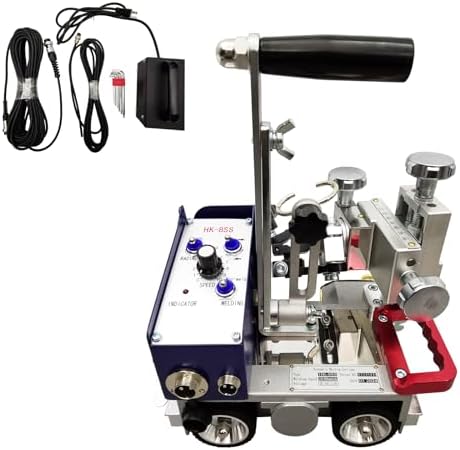
This industrial welder is designed for high-quality fillet welding in sectors like construction, petroleum, and mining. It uses a four-wheel drive system to keep the movement stable, which helps reduce errors that often cause welding defects in manual processes. By distributing driving force evenly across all wheels, the unit maintains a consistent path even on complex workpieces.
The high-precision gear transmission mechanism further stabilizes the machine. It effectively eliminates shaking, ensuring the torch follows your preset trajectory without mechanical drift.
The control panel is designed to be intuitive, allowing operators to switch between vertical and horizontal corner welding modes quickly. It’s best suited for industrial professionals who need a portable, automated solution for consistent metal joining. Because the unit operates at speeds ranging from 150 to 900mm/min, it provides the efficiency required for heavy-duty site work. This tool isn’t for hobbyists or those looking to learn basic circuit soldering.
Pros
- Four-wheel drive ensures stable movement
- High-precision gears reduce mechanical shaking
- Two distinct corner welding modes
Cons
- Requires industrial power and setup
- Not suitable for basic electronics learning
2. Recfountik Welding Practice Car

Avoids the trap of: Ignoring the need for assembly by providing clear marks.
This kit is built for beginners who want to practice soldering on a blue PCB. It uses a classic LM393 comparator circuit to follow a 15mm black line, which is a great way to learn how light reflection controls motor movement. You gain a practical understanding of optical sensing and motor control without needing any programming knowledge.
The board has clear component positions, which helps prevent the common errors that often occur during a first-time build. It’s perfect for students or hobbyists who want a hands-on project to understand circuit principles. Because the unit relies on precise manufacturing, you must carefully check component orientation before soldering to avoid virtual joints. Doing so ensures the car performs as intended once you finish the assembly.
This kit isn’t for users who need a ready-to-use robot, as it requires manual soldering and assembly to function. You’ll need to provide your own 3v power source, specifically two AA batteries, to get the motors running.
Pros
- Clearly marked component positions on PCB
- Uses standard LM393 comparator circuit
- Simple design for beginner practice
Cons
- Requires 2 AA batteries not included
- Assembly is mandatory for function
3. The Lord of the Tools 1 Set Smart Car Soldering
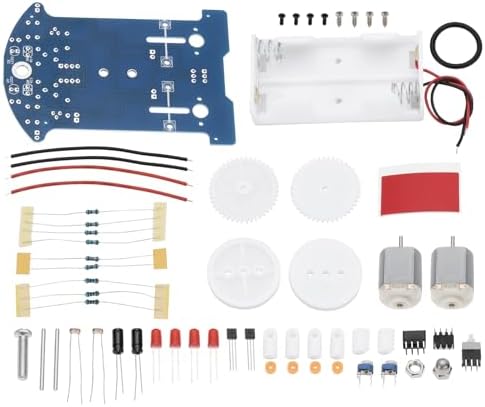
Avoids the trap of: Misunderstanding the sensor technology by using light reflection.
This set allows you to build a smart car that tracks paths using black electrical tape. It’s an educational tool that requires you to apply basic electronic theory and welding skills to make the robot function autonomously.
The board is clearly labeled, making it a straightforward project for science fairs or classroom demonstrations. It’s ideal for electronics enthusiasts who want to see how light sensors influence motor direction. Because the system relies on identifying the contrast between black and white surfaces, you can create complex paths on your floor. This isn’t for users without prior knowledge of basic electronics or soldering.
The kit functions by reading light reflection to navigate. By laying down 1.5 to 2.0 cm black electrical tape, you provide the robot with a clear path to follow. It identifies the line direction and adjusts its motors automatically to stay on course. Comparing the listings based on their own provided specifications bridges the gap between abstract theory and mechanical movement. You gain a practical understanding of how sensors interpret environmental data to drive physical action.
Pros
- Customizable tracks using electrical tape
- Straightforward, illustrated assembly connections
- Ideal for STEM learning projects
Cons
- Requires basic electronic theory knowledge
- Batteries must be purchased separately
4. Aueabc Smart Line Follower Robot Car DIY Soldering Kit

Avoids the trap of: Overlooking power and battery requirements by specifying 3V DC.
This model uses a high-quality FR4 PCB and is designed specifically for through-hole soldering practice. It features a closed-loop control system where the car slows or stops one motor to turn, effectively following lines even on curved paths.
Because it uses discrete through-hole components, it’s easier to solder than boards with tiny surface-mount parts. This makes it a great choice for physics courses or after-school projects. It isn’t for anyone expecting an advanced programmable robot, as it relies on simple analog logic.
The kit functions by using two photosensitive resistors and LEDs to detect light reflection differences between a black track and a white surface. The LM393 comparator IC then analyzes these signals to adjust motor speed. This process works on both pre-printed tracks and your own custom paths made with black tape.
Pros
- Through-hole design is beginner-friendly
- Responsive closed-loop control logic
- High-quality FR4 circuit board
Cons
- Unassembled raw components only
- AA batteries aren’t included
- Lacks programmable features or advanced microcontrollers
5. FRETTEATRI Obstacle Robot

Avoids the trap of: Misunderstanding the sensor technology by using ultrasonic ranging.
This tool is built for students who want to practice welding while learning about obstacle avoidance. It uses ultrasonic sensors to detect objects, providing a different challenge than simple line-following robots. By measuring sound waves to calculate distance, the robot actively navigates around barriers rather than just following a pre-set path.
The components are designed for reliability, and the kit includes support for those who run into installation questions. It’s a solid choice for those interested in automotive or household electronics applications. Because the logic centers on proximity detection, this isn’t for someone who specifically wants to learn about line-tracking or path-following logic. You should choose this if you want to understand how hardware interacts with physical space in real time.
Pros
- Uses ultrasonic modules for ranging
- Designed for student practice
- Includes customer support for questions
Cons
- Requires assembly of all parts
- Limited to obstacle avoidance logic
Car Welding Robots Black Friday & Cyber Monday Deals
Car welding robots are built for production lines, so the buyers who look at them are usually manufacturers, contract welders, and facilities planning automation. Before comparing options, check the robot’s reach and load capacity against your parts, whether its controller works with your welding power source, and how much floor space and programming support you will need.
Before You Order
Confirm if you have a soldering iron and lead-free solder at home. Measure your workspace to ensure it fits the robot’s track requirements. Check if your project requires AA batteries or a specific power supply. Verify if the kit includes a manual or if you need to find electronic assembly standards online.
The biggest trap when buying these kits is confusing an industrial machine with a DIY learning kit. If you’re an industrial user, the BEILOCKERY Welding Buggy is the clear choice for professional work. It provides high-precision gear transmission and an intelligent control system for consistent, automated welding.
If you want to learn, pick one of the soldering kits above, but ensure you have the necessary tools to complete the assembly. These educational kits, such as the Recfountik or Aueabc models, arrive as unassembled raw components. You must be prepared to handle through-hole components and follow clearly marked PCB layouts.
Start by checking your soldering equipment before you place your order. Verify the voltage requirements, as the listings state the kits operate on 3V or 4.5V power sources that aren’t included. Confirming these details ensures you can begin your project immediately upon delivery rather than waiting for extra parts.
Frequently Asked Questions About Best Car Welding Robots
Is the simplest one on this list enough?
Yes, for a beginner, the simplest kit provides everything needed to learn the basics of soldering and circuit logic. These kits focus on fundamental principles like light reflection and motor control. They’re designed to teach you how to build a circuit from raw components, which is the most important step for any electronics student.
What if it turns out to be the wrong one?
If you realize the kit is too complex or not what you intended, check the component list before you begin soldering. Once you solder parts to the board, you can’t easily return the item. Always verify the assembly requirements and the specific function of the robot—line-following versus obstacle-avoidance—before opening the packaging.
What gives out or runs out first?
The most common items to run out are the batteries, which are almost never included in the box. Aside from power, the soldering iron tip is a component that may require replacement if you’re practicing for long periods. Keep a spare tip and fresh batteries ready so your learning process isn’t interrupted by a lack of basic supplies.
Which trap catches most people twice?
Most people fall for the “ready-to-run” trap. They see a robot and assume it arrives assembled and working. When the box arrives, they’re surprised to find a bag of loose parts and a bare circuit board. This happens to even experienced buyers who forget to check if the kit is labeled as an “unassembled” or “DIY” project.
Conclusion
Whether you are outfitting a factory floor or setting up a hobbyist workbench, the right tool makes all the difference. Don’t rush your decision; take a moment to double-check your workspace’s electrical capacity today. You’ll find that once you’ve matched the machine to your needs, your projects will run much smoother.
Disclosure: As an Amazon Associate, I may earn from qualifying purchases at no extra cost to you. Amazon and the Amazon logo are trademarks of Amazon.com, Inc, or its affiliates.
- Amazon, Amazon Prime, the Amazon logo and Amazon Prime logo are trademarks of Amazon. com, Inc. or its affiliates.

I am Sadman, the founder of CarSensorHub.com, where I share my passion for cars and technology. I specialize in writing detailed reviews and helpful guides on car gadgets, accessories, safety tools and many more. My mission is to help car owners discover the best products and tips to improve their driving experience and stay safe on the road.


