Testing The Ford F-150 Maf Sensor With A Multimeter
The Ford F-150 is one of the most popular trucks in the United States. It’s known for reliability, but even the best vehicles need maintenance. One common issue is with the MAF sensor (Mass Air Flow sensor). This sensor measures air entering the engine, which helps control fuel injection and ensures smooth operation. If the MAF sensor isn’t working right, your truck may idle rough, lose power, or show a check engine light. Testing the MAF sensor with a multimeter can help you find problems before they get serious. Let’s look at how to test the Ford F-150 MAF sensor step by step, with practical tips and details for beginners.
What Is A MAF Sensor?
The MAF sensor is a small electronic device. It sits between the air filter and the throttle body. Its job is to measure how much air flows into the engine. The truck’s computer uses this information to mix air and fuel for best performance. If the sensor gives wrong readings, the engine may run too rich (too much fuel) or too lean (not enough fuel).
The MAF sensor uses a tiny wire or film. When air flows past this wire, it cools down. The sensor measures how much the wire cools, then sends a voltage signal to the engine computer. This signal helps the computer decide how much fuel to inject.
For example, more air means the computer adds more fuel. This keeps the engine running smooth and efficient.
Signs Of A Bad Maf Sensor
Before testing, know the symptoms that suggest a faulty sensor:
- Check engine light appears.
- Rough idle or stalling.
- Poor acceleration.
- Reduced fuel economy.
- Hesitation or surging during driving.
A bad MAF sensor can also cause the engine to misfire or run unevenly. Sometimes, the symptoms are mild at first, like a slight drop in miles per gallon or a small change in engine sound. If the sensor is very dirty or damaged, the truck might not start at all.
It’s important to notice these signs early, as driving with a faulty sensor can damage other parts, like the spark plugs or catalytic converter.
Sometimes, these signs are caused by other issues. Testing with a multimeter helps confirm if the MAF sensor is the problem.
Credit: www.f150forum.com
Tools You Need
To test the MAF sensor, gather:
- Digital multimeter (preferably auto-ranging)
- Screwdriver (to remove sensor)
- Gloves and safety glasses
- Service manual for the Ford F-150 (optional, but helpful)
- Pen and paper to record results
You might also want a flashlight to help see wires and connections, especially if working in low light or tight spaces. Some people use a phone camera to take pictures before removing parts. This helps remember where each wire goes.
Safety Tips Before Testing
- Turn off the engine and remove the key.
- Let the engine cool to avoid burns.
- Disconnect the battery to prevent shorts.
- Wear gloves and safety glasses.
Testing an electrical part can be dangerous if you don’t follow precautions.
If you need to test with the engine running, make sure loose clothing, jewelry, or hair are kept away from moving parts. Always work in a well-ventilated area. If you are unsure about any step, ask someone experienced for help.
Safety first, especially when working around batteries and electrical wires.
Locating The Maf Sensor On Ford F-150
The MAF sensor sits in the air intake tube, just after the air filter box. Look for a small rectangular part with wires going to it. On most F-150s, the sensor is easy to reach.
If you are not sure, trace the air intake from the front of the engine. The air filter box is usually a large plastic box, and the intake tube runs toward the throttle body. The MAF sensor is often attached with screws or clips, and has a connector with several wires.
Some models have the sensor built into the air filter housing, so check your manual or look for markings that say “MAF. ”
Steps To Test The Ford F-150 Maf Sensor With A Multimeter
1. Inspect The Sensor Visually
Check for:
- Loose or damaged wires
- Dirt or oil on the sensor
- Broken connector pins
If the sensor is dirty, use a MAF sensor cleaner spray. Hold the spray a few inches away and apply gentle bursts. Wait until the sensor is completely dry before reinstalling. Avoid using compressed air or touching the wire inside, as it can break easily.
Also, check for cracks in the plastic housing. Sometimes, water or oil can get inside and cause corrosion. If the connector pins are bent or missing, the sensor cannot send correct signals to the computer.
2. Identify The Sensor Wires
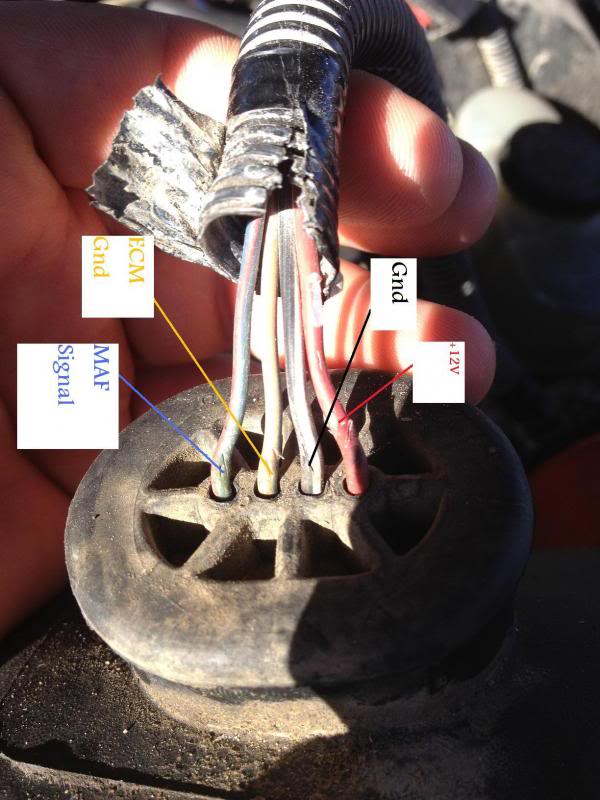
Most Ford F-150 MAF sensors have 3 to 5 wires:
- Power wire (usually 12V)
- Ground wire
- Signal wire (outputs voltage to ECU)
- Sometimes, IAT wires (Intake Air Temperature)
Check your manual for wire colors.
On some models, the signal wire might be a different color, such as gray or green. If you don’t have a manual, search online for your F-150’s year and engine type. A wiring diagram can help you avoid mistakes. Mark each wire with tape or write it down before testing.
3. Set Your Multimeter
Turn your multimeter to DC voltage. If it’s not auto-ranging, set it to 20V.
Some multimeters have a “continuity” setting. For this job, stick to DC voltage. Make sure the leads are plugged in correctly (red in “VΩ,” black in “COM”). Double-check the battery level in your multimeter, as low power can cause false readings.
4. Testing The Power Wire
- Reconnect the battery.
- Turn the key to “ON” (engine off).
- Probe the power wire (red lead to wire, black to ground).
- You should see 12V.
If there’s no voltage, the sensor isn’t getting power. Check fuses and wiring.
If the voltage is lower than expected, like 10V or less, the battery may be weak or the wiring may have resistance. Sometimes, corrosion in connectors can drop the voltage. Clean the contacts and try again. If you see 12V, move to the next step.
5. Testing The Ground Wire
- Switch the black lead to the sensor ground wire.
- You should see 0V or very close.
If you see voltage, the ground may be faulty.
A good ground is important for accurate readings. If the ground wire shows more than 0. 1V, check for rust or loose connections where the wire connects to the frame or battery. Sometimes, adding a new ground wire can solve stubborn problems.
6. Testing The Signal Wire
- Start the engine.
- Probe the signal wire with the red lead.
- At idle, typical voltage is 0.6–1.0V.
- Rev engine to 2500 RPM; voltage should rise to 1.5–2.0V.
If voltage doesn’t change, the sensor is likely bad.
For best results, have a helper rev the engine while you watch the multimeter. If the voltage jumps quickly or flickers, the sensor may be loose or the wire may be broken inside. Sometimes, the signal wire gives a steady reading at idle, but fails to climb with RPM.
This means the sensor is not measuring airflow correctly.
Example Of Typical Readings
| Condition | Expected Voltage |
|---|---|
| Engine Off (Key ON) | 0V (Signal Wire) |
| Engine Idle | 0.6–1.0V (Signal Wire) |
| Engine Revved (2500 RPM) | 1.5–2.0V (Signal Wire) |
7. Compare To Ford F-150 Standards
MAF sensor voltage can vary by year and engine type. Check your service manual for exact values. If your readings are far from standard, the sensor may need replacement.
Some F-150s with turbo engines have slightly higher signal voltages. Always check the specs for your exact model. If your readings are close but not perfect, try cleaning the sensor and retesting. If still out of range, replace the sensor.
Common Mistakes When Testing Maf Sensors
- Testing with engine off: Signal voltage only works with engine running.
- Touching sensor wires: Skin oils can damage the sensor.
- Using wrong multimeter setting: Always use DC voltage, not AC.
- Forgetting to check ground: Bad ground can cause false readings.
- Ignoring connector cleanliness: Dirty connectors lead to poor results.
Another mistake is skipping the visual inspection. Sometimes, a sensor looks fine but has a cracked housing or water inside. If you test without checking, you may miss the real problem. Also, never force the connector off. If it’s stuck, use a small tool to gently release it.
Practical Tips For Accurate Testing
- Use alligator clips for stable connections.
- Record readings at idle and higher RPMs.
- Compare readings to manufacturer data.
- Replace sensor if readings are far from normal.
Take your time and double-check each step. If you get confusing readings, test again after cleaning the sensor and connector. Don’t guess—compare your numbers to the data for your F-150. If readings are off, and you’ve checked wires and ground, it’s time to replace the sensor.
If the sensor passes all tests but symptoms remain, check for air leaks or other issues.
Sometimes, an intake hose is loose or cracked. Even a small leak can confuse the sensor and cause rough running. Inspect all hoses and clamps, and make sure the air filter is clean. If everything else checks out, the problem may be elsewhere, like the throttle body or spark plugs.
How The Maf Sensor Affects Ford F-150 Performance
The MAF sensor is crucial for:
- Fuel efficiency
- Smooth acceleration
- Idle stability
- Emissions control
A bad sensor can cause the truck to use more fuel and produce more emissions. Even a small voltage error can affect engine performance.
If the sensor fails, the computer may switch to backup mode, using preset values instead of real data. This can cause the truck to run too rich or too lean. You may notice black smoke from the tailpipe or smell fuel.
Sometimes, the engine will “hunt” for idle, revving up and down unexpectedly. Fixing the sensor quickly prevents long-term damage and keeps your truck running well.
Data Table: Ford F-150 Maf Sensor Voltage By Model Year
| Model Year | Idle Voltage | 2500 RPM Voltage |
|---|---|---|
| 2010 | 0.7V | 1.8V |
| 2015 | 0.8V | 1.9V |
| 2020 | 0.9V | 2.0V |
These values are typical, but small changes are normal. If your readings are much lower or higher, check for intake leaks, dirty air filters, or sensor faults.

Credit: www.youtube.com
When To Replace The Maf Sensor
Replace the sensor if:
- Signal voltage does not change with RPM
- Readings are far from standard values
- Cleaning does not fix issues
- Wiring and connectors are good, but symptoms persist
A new sensor restores performance and fuel economy.
When replacing, always use an OEM (original equipment manufacturer) sensor. Aftermarket sensors may not work as well and can cause new problems. After installation, clear the check engine light using a scan tool or by disconnecting the battery for a few minutes.
Test the truck again to confirm smooth running.
Non-obvious Insights For Beginners
- MAF sensors can fail slowly. You may notice only minor issues at first, like slight hesitation or reduced MPG. Early testing can prevent bigger problems.
- Low voltage on signal wire isn’t always a bad sensor. Sometimes, it’s caused by clogged air filters or leaks in the intake system. Always check these before replacing the sensor.
Many beginners believe the sensor is bad if the voltage is out of range. But sometimes, a simple cleaning or fixing a loose connector solves the problem. Also, if you change the air filter, retest the sensor to make sure the readings improve.
Comparison Table: Maf Sensor Vs Map Sensor
| Feature | MAF Sensor | MAP Sensor |
|---|---|---|
| Measures | Air flow | Manifold pressure |
| Location | Air intake tube | Intake manifold |
| Effect on performance | Direct fuel mix | Indirect fuel mix |
| Common issues | Dirty sensor, faulty wiring | Vacuum leaks, sensor failure |
Some engines use both sensors for more accurate control. If your F-150 has a MAP sensor, check it separately if you still have issues after fixing the MAF sensor.
What To Do After Testing
- If sensor is good, check air filter, intake hoses, and connectors.
- If sensor is bad, replace with OEM part for best results.
- Always clear the check engine light after repairs.
After testing, it’s a good idea to test drive your truck and see if the symptoms are gone. If not, scan for error codes with an OBD-II scanner. This can help find hidden problems, like intake leaks or fuel injector faults.
Where To Find More Information
For more technical details, you can visit the official Ford service site or a trusted source like AutoZone.
FAQs About Testing Ford F-150 MAF Sensor With Multimeter
How Often Should I Test My Ford F-150 Maf Sensor?
Test the MAF sensor every 30,000 miles or if you notice performance issues like rough idle or poor acceleration.
If you drive in dusty areas or tow heavy loads, check the sensor more often. Dirt and debris can build up faster and cause early sensor failure.
Can I Clean The Maf Sensor Instead Of Replacing It?
Yes, you can use MAF sensor cleaner. Spray the sensor gently, let it dry, and reinstall. Do not use other cleaners or touch the sensor wire.
Sometimes, cleaning solves the problem for several months. If symptoms return, the sensor may be failing and need replacement.
What Happens If I Ignore A Bad Maf Sensor?
A bad MAF sensor can cause engine damage, low fuel economy, and failed emissions tests. It’s best to fix it soon.
Over time, a bad sensor can also damage the catalytic converter, which is expensive to replace. Fixing small issues early saves money and keeps your truck reliable.
Is The Maf Sensor The Same As The Map Sensor?
No. The MAF sensor measures air flow, while the MAP sensor measures air pressure in the intake manifold. Both affect fuel mix.
Some F-150s have both sensors. If you replace one and problems remain, test the other for faults.
Can I Drive With A Faulty Maf Sensor?
You can drive short distances, but performance will suffer. It’s unsafe for long trips. Replace the sensor as soon as possible.
If you must drive, avoid heavy acceleration and monitor the engine for unusual sounds or performance changes.
Testing your Ford F-150 MAF sensor with a multimeter is a simple way to keep your truck running smooth. With careful steps and attention to detail, you can find problems early and fix them before they lead to expensive repairs.
Always follow safety rules and compare your readings to the manufacturer’s standards. If you’re unsure, ask a professional for help. Regular maintenance, including checking the MAF sensor, ensures your F-150 remains reliable for years to come.
Disclosure: As an Amazon Associate, I may earn from qualifying purchases at no extra cost to you. Amazon and the Amazon logo are trademarks of Amazon.com, Inc, or its affiliates.
- Amazon, Amazon Prime, the Amazon logo and Amazon Prime logo are trademarks of Amazon. com, Inc. or its affiliates.

I am Sadman, the founder of CarSensorHub.com, where I share my passion for cars and technology. I specialize in writing detailed reviews and helpful guides on car gadgets, accessories, safety tools and many more. My mission is to help car owners discover the best products and tips to improve their driving experience and stay safe on the road.