Choosing the right heavy Duty Tow Strap often leads to frustration because buyers prioritize length over actual strength ratings. Most people assume a longer strap is always better, but this ignores the critical need for proper vehicle recovery weight limits. This guide cuts through the marketing noise to show you which gear is built for real-world stress and which is merely for show. The mistake that’s hardest to undo is buying a strap that doesn’t match your vehicle’s weight, but the BANJEYSTRAPS Recovery Tow Strap helps you avoid this risk entirely.
What Buyers Get Wrong
Ignoring the vehicle weight limits
Buyers often see a high weight capacity and assume it works for any truck or SUV. This is a dangerous mistake because a strap must be matched to the weight of the vehicle being recovered. If you use a strap with a rating lower than the weight of your stuck vehicle, it will likely break under the force of a pull. Always check your vehicle’s gross weight and compare it to the break strength of the Heavy Duty Tow Strap before you head onto the trails.
Choosing length over proper strength
Many shoppers believe a longer strap is safer because it keeps cars further apart. While distance is important, a very long strap can be harder to manage and may sag, creating a hazard. A shorter, higher-strength strap is often safer and easier to store in your vehicle. Prioritize the material quality and break strength rating over the extra feet, as the structural integrity of the strap matters far more during a recovery than the distance between vehicles.
Confusing towing with kinetic recovery
People often use standard tow straps for kinetic recovery, but they aren’t the same thing. A static tow strap is designed for pulling a vehicle on flat ground, while a kinetic strap is built to stretch and absorb shock. Using a static strap for a deep mud recovery can cause a violent snap-back that damages your vehicle’s frame. Understand the difference between a static pull and a dynamic recovery before choosing your equipment to ensure you don’t damage your recovery points.
Overlooking the connection hardware quality
A strap is only as strong as its weakest point, which is often the connection hardware. Buyers frequently focus on the strap material but ignore the quality of the shackles or hooks included in the kit. If the included hooks or shackles aren’t rated for the same weight as the strap, the hardware will fail first. Always inspect the rating on your D-ring shackles to ensure they can handle the same load as the strap, preventing a catastrophic failure during use.
What Did Not Make the List

- 45,000 lb break strength
- 4-inch wide polyester webbing
- Includes two 3/4" forged steel shackles
- For off-road and emergency use

- 50 US Ton break strength
- Works from -40°F to 200°F
- 7.1-inch width and 20ft length
- Resists oil, saltwater, and sun
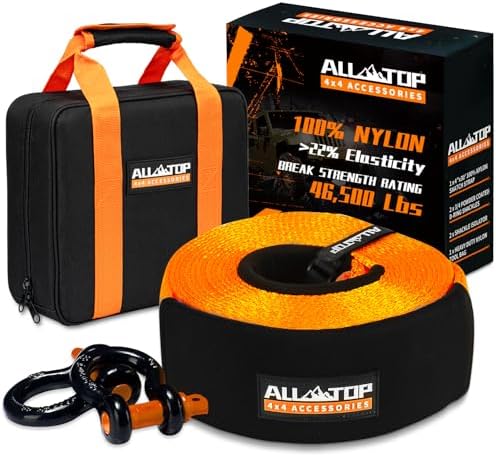
- 100% Nylon N66 material
- 9m length and 102 mm width
- 46500 Lbs break strength
- Includes reinforced loops and sleeves

- 3" x 30Ft strap with two 3/4" shackles
- 36,000 lbs lab-tested break strength
- Electro-galvanized 3/4" D-ring shackles
- For off-road and emergency recovery

- For agricultural and utility vehicles
- 70,000 lb MBS and 23,333 lb WLL
- 4.7-inch wide 2-ply polyester webbing
- Available in 20 ft or 30 ft

- 2-inch strap with 20,000 lb strength
- 40 ft length
- Carbon steel hooks with safety clips
- High visibility orange color

- Durable polyester construction
- Designed for flat surface towing
- Triple reinforced loop ends

- 3 inches wide and 30 feet long
- 30,000lbs capacity polyester webbing
- CE and TUV tested

- 20 FT long, 2 In. wide
- 10,000 lbs pulling capacity
- Polyester strap with safety buckle hooks

- 50 US Ton break strength
- Works from -40°F to 200°F
- Three-layer reinforced eye ring design
- 20ft length, water and UV resistant
1. 45,000 lb Recovery Tow Strap Kit with 3/4″ Shackles(2pcs)
Avoids the trap of: ignoring the vehicle weight limits by providing a clear 45,000 lb rating.
This kit is built for extreme recovery scenarios, featuring high-tensile polyester webbing that offers controlled elasticity. The 4-inch width helps distribute force evenly, which is essential when pulling heavy-duty trucks or loaded SUVs from deep mud or sand. It’s a solid choice for off-roaders who need a reliable, all-in-one system that includes the necessary shackles for a secure, direct connection to your vehicle’s frame.
This product isn’t for the occasional driver who only needs to pull a lightweight sedan on a paved road, as its extreme strength rating and size are overkill for minor roadside assistance. If you drive a small city car, the massive bulk of this kit may be difficult to store and unnecessary for your specific recovery needs.
Pros
- Immense 45,000 lb break strength rating.
- Includes two heavy-duty 3/4″ D-ring shackles.
- UV-resistant polyester webbing for long life.
Cons
- May be too bulky for small storage spaces.
- Over-engineered for light passenger vehicle recovery.
2. 90,000lb Heavy Duty Tow Strap 30ft x 7.1Inch
Avoids the trap of: choosing length over proper strength by offering a massive 90,000 lb rating.
This strap is designed for the most demanding commercial and heavy-duty environments. With a 7.1-inch width, it spreads the pressure across a larger surface area, which helps protect your vehicle during intense pulls. The three-layer reinforced eye design ensures that the connection points remain durable even after repeated use in harsh conditions, making it a dependable tool for professional recovery operations.
Pros
- Massive 90,000 lb break strength rating.
- Designed to withstand temperatures down to -40°F.
- Three-layer reinforced eye rings for durability.
Cons
- Extremely wide and heavy for standard vehicles.
- Best suited for commercial-grade recovery tasks.
3. ALL-TOP Extreme Duty Tow Strap Recovery Kit
Avoids the trap of: confusing towing with kinetic recovery by using 100% nylon for elasticity.
The 22% elongation provided by the nylon N66 material makes this a true snatch strap, designed to absorb energy and reduce shock on your vehicle’s recovery points. It’s ideal for drivers who frequently deal with deep sand or mud where a dynamic pull is required to break the suction. The inclusion of neoprene protector sleeves adds a layer of safety, preventing the loops from fraying against metal edges.
This strap isn’t meant for simple towing on flat, paved surfaces, as the high elasticity can make it difficult to control the distance between two vehicles. If you’re looking for a static tow strap to pull a vehicle in a straight, controlled line, the stretch of this nylon material may cause more frustration than assistance.
Pros
- 22% elasticity for safer dynamic recoveries.
- Durable 100% nylon N66 construction.
- Comes with a very long-term warranty.
Cons
- Not ideal for static towing on pavement.
- Elasticity requires more space for safe operation.
4. 3″ x 30Ft Recovery Tow Strap Heavy Duty with Hooks
Avoids the trap of: overlooking the connection hardware quality by including reinforced D-ring shackles.
This kit offers a balanced approach for off-roaders who want a complete solution out of the box. The 36,000 lb break strength is well-suited for most SUVs and trucks, providing a strong margin of safety for typical trail obstacles. The inclusion of protective bumpers on the shackles is a thoughtful touch that helps prevent cosmetic damage to your vehicle’s bumper during the recovery process.
If you’re operating in heavy agricultural environments, you may find that this strap reaches its limit when used with heavier-duty alternatives.
Pros
- Includes reinforced 3/4″ D-ring shackles.
- Protective bumpers prevent vehicle paint damage.
- Lab-tested 36,000 lb break strength.
Cons
- Lower break strength than heavy-duty industrial straps.
- Not designed for heavy agricultural or commercial use.
5. Dawnerz Heavy Duty Tow Strap 30ft 70000 lbs MBS Recovery
Avoids the trap of: ignoring the vehicle weight limits by providing a 3:1 safety factor rating.
This strap is specifically engineered for agricultural and utility vehicles, making it the go-to for farmers and service truck operators. The 2-ply polyester webbing is highly resistant to common farm contaminants like oils, grease, and saltwater, ensuring it holds up in messy work environments. It’s a no-nonsense tool that focuses on reliability and strength in demanding, non-recreational settings.
This strap isn’t intended for the weekend off-roader who wants a lightweight, compact kit for their Jeep. The materials and design are optimized for heavy farm equipment, meaning it’s significantly heavier and less flexible than straps designed for recreational vehicle recovery.
Pros
- Built specifically for agricultural and utility vehicles.
- Resistant to oil, grease, and saltwater.
- High 23,333 lb working load limit.
Cons
- Heavy and less flexible for recreational use.
- Specifically optimized for non-recreational utility tasks.
6. TOPZEA Heavy Duty Tow Strap with Hooks
Avoids the trap of: choosing length over proper strength by providing a 40 ft reach.
The 40-foot length is the standout feature here, offering a much larger safety buffer than standard 20-foot straps. This is especially useful in complex recovery scenarios where you can’t get your recovery vehicle close to the stuck one. The high-visibility orange color makes it easy to spot in low-light or snowy conditions, which adds a layer of safety during roadside emergencies.
This strap isn’t designed for heavy-duty, high-load recoveries, as its 20,000 lb break strength is on the lower end for this category. If you’re attempting to pull a heavy truck or tractor, this strap may not provide the necessary margin of safety required for such a high-stress task.
Pros
- 40 ft length allows for safer pulling distances.
- Bright orange for high visibility.
- Includes hooks with spring-loaded safety clips.
Cons
- Lower break strength limit of 20,000 lbs.
- Hooks may be less secure than D-ring shackles.
7. Rhino USA Recovery Tow Strap (3in x 20ft)
Avoids the trap of: overlooking the connection hardware quality by using triple-reinforced loop ends.
This static strap is built for durability, focusing on the longevity of the connection points. The triple-reinforced ends are designed to withstand the high stress of flat towing, where abrasion and wear are the biggest enemies of standard straps. It’s a straightforward, reliable choice for drivers who want a product backed by a consistent replacement policy.
This strap isn’t a kinetic recovery tool, so it shouldn’t be used for “snatching” a vehicle out of deep mud, as it lacks the necessary elasticity. If you attempt to use this for a dynamic pull, you risk damaging your vehicle’s frame because the strap doesn’t stretch to absorb the shock of the jerk.
Pros
- Triple-reinforced ends for extreme wear resistance.
- Designed specifically for flat surface recovery.
- Backed by a lifetime replacement policy.
Cons
- Static strap lacks the elasticity for snatching.
- Not intended for deep mud or snow recovery.
8. HFS Tree Saver Strap
Avoids the trap of: confusing towing with kinetic recovery by acting as a specialized tree saver.
This strap is designed to be wide and tough, which makes it perfect for wrapping around trees to protect the bark during a winch operation. Its 3-inch width and polyester construction provide a stable, non-stretching connection that ensures your winch line stays secure. It’s a simple, effective tool that every winch user should have in their gear bag.
This strap isn’t meant to be used as a primary tow strap for long-distance vehicle recovery, as it’s optimized for stationary winch work. If you try to use this for dynamic or long-distance towing, you’ll find it lacks the specialized features and length required for those tasks.
Pros
- The extra-thick, multi-ply construction provides a robust barrier to protect tree bark.
- Strong 30,000 lb capacity for winching.
- Simple, reusable, and easy to store.
Cons
- Not ideal for long-distance towing.
- Lacks elasticity for kinetic recovery pulls.
9. NEIKO 51005A Heavy-Duty Tow Strap with Hooks
Avoids the trap of: ignoring the vehicle weight limits by being tailored for lighter consumer vehicles.
This is a practical, user-friendly strap for the average car or light truck owner. The 10,000 lb capacity is perfectly suited for smaller vehicles, and the inclusion of hooks with safety buckles makes it very easy to attach to standard tow points. It’s the ideal “just in case” tool for a roadside emergency kit where you don’t need industrial-grade heavy equipment.
This strap isn’t for heavy-duty off-roading or recovering large trucks, as the 10,000 lb limit is far below what is required for those vehicles. If you drive a large SUV or a work truck, this strap will likely fail, and it isn’t safe to use for anything beyond light passenger vehicle recovery.
Pros
- Easy to install with safety-buckle hooks.
- Bright yellow for high visibility.
- Compact and lightweight for emergency kits.
Cons
- Low 10,000 lb capacity is for light vehicles only.
- Not suitable for heavy-duty or off-road recovery.
10. Heavy Duty Recovery Tow Strap 20ft x 7.1 Inch
Avoids the trap of: choosing length over proper strength by focusing on extreme break strength.
Similar to the larger Pilida rope, this 20-foot version offers the same 90,000 lb break strength in a more manageable length. The industrial polyester is built to survive in extreme climates, from arctic ice to desert heat, without losing its integrity. This is a top-tier choice for professional overlanders who need a strap that won’t fail regardless of the environment.
This strap isn’t for the casual user who only needs to pull a stuck car out of a ditch, as the extreme strength and width make it overkill for standard passenger vehicles. The heavy-duty nature of this strap means it’s harder to fold and stow than lighter, consumer-grade options.
Pros
- Massive 90,000 lb break strength.
- Withstands extreme temperatures from -40°F to 200°F.
- Chemical and UV-resistant industrial polyester.
Cons
- Overkill for standard passenger vehicle recovery.
- Less flexible than consumer-grade tow straps.
Before You Order
- Confirm that your vehicle has frame-mounted recovery points or tow hooks that are rated for the load.
- Check the dimensions of your storage area to ensure the strap’s width and length will fit comfortably.
- Verify the type of connection points on your vehicle to see if you need shackles or hooks.
The biggest trap in this category is buying based on length rather than the specific weight rating required for your vehicle. The BANJEYSTRAPS Recovery Tow Strap consistently avoids this by offering a clear, high-strength rating that’s easy to verify against your vehicle’s needs. Before you finalize your choice, ensure you have checked your vehicle’s manual for the recommended recovery points, as industry safety standards define the critical requirements for proper load-bearing equipment.
Related guides
- Heavy-Duty Tow Straps for Ford F-150: Ultimate Strength and Reliability
- 7 Best Heavy Duty Tow Straps With Hooks for Ford Fusion | Reviewed
- Tow Hook for C8 Corvette 2026: Your Ultimate Buying Guide
FAQs Of Best Heavy Duty Tow Strap Black Friday & Cyber Monday Deals 2026
Is the simplest one on this list enough?
For most passenger vehicles, the simplest strap is often the most effective. If your goal is basic roadside assistance for a car or light truck, you don’t need the massive industrial-grade straps. A strap rated for 10,000 to 20,000 lbs is usually sufficient, provided you aren’t performing extreme off-road recoveries. Always prioritize the correct weight rating for your specific vehicle over buying the largest, most complex kit available.
What if it turns out to be the wrong one?
If you realize your strap isn’t rated for your vehicle’s weight, don’t attempt to use it. Most manufacturers offer a return policy, and it’s far safer to exchange it for the correct rating than to risk a failure. Always check the weight rating against your vehicle’s curb weight immediately upon arrival.
What gives out or runs out first?
The most common point of failure is the connection point, specifically the stitching on the loops or the metal hardware itself. The listing notes that the polyester webbing is resistant to UV exposure and abrasion from dirt. The listing doesn’t mention when to retire the strap.
Which trap catches most people twice?
Never use a static strap for dynamic recovery, as it lacks the elasticity required to safely snatch a vehicle from mud. Static straps are prone to snapping under shock loads, potentially damaging your vehicle’s frame. Always use a kinetic strap for off-road recovery to safely absorb the energy of the pull.
Conclusion
Safety shouldn’t be a guessing game when you’re stuck in the mud. Once you’ve picked the right gear, keep it stored in a dry, accessible spot in your trunk. You’ll be glad it’s there the next time you’re helping a friend out of a tough spot on the trail.
Disclosure: As an Amazon Associate, I may earn from qualifying purchases at no extra cost to you. Amazon and the Amazon logo are trademarks of Amazon.com, Inc, or its affiliates.
- Amazon, Amazon Prime, the Amazon logo and Amazon Prime logo are trademarks of Amazon. com, Inc. or its affiliates.

I am Sadman, the founder of CarSensorHub.com, where I share my passion for cars and technology. I specialize in writing detailed reviews and helpful guides on car gadgets, accessories, safety tools and many more. My mission is to help car owners discover the best products and tips to improve their driving experience and stay safe on the road.